Tuesday, January 3, 2017

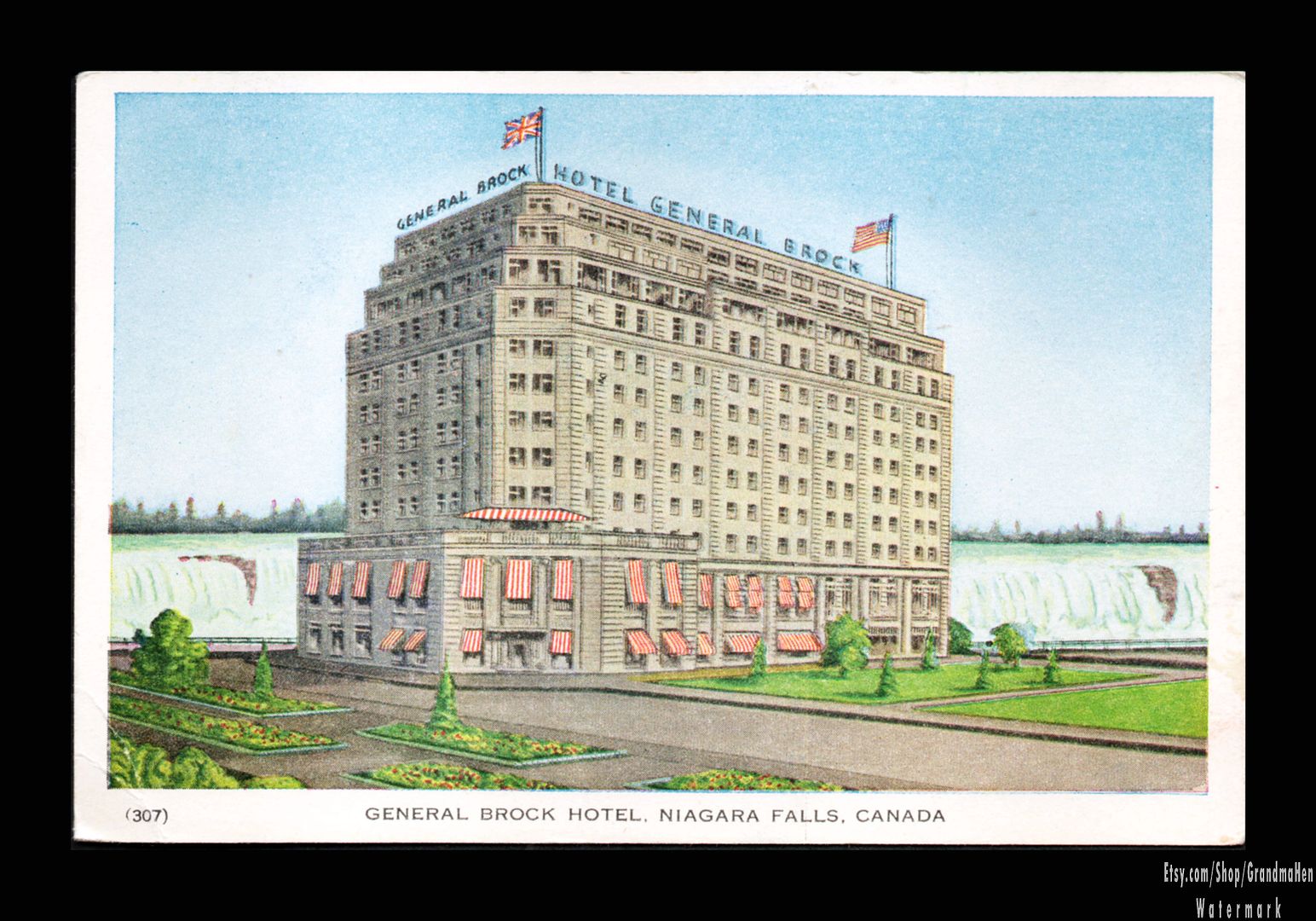
General Brock Hotel Niagara Falls Canada Vintage Color Halftone Postcard

General Brock Hotel ca. 1948
General Brock Hotel
Niagara Falls, Canada
No. 307
Printed in Canada
3-5/8 x 5-1/2 inches
Divided Back, Blank Stamp Box

Blog Post by Mary Katherine May. Rick and Mary May operate QualityMusicandBooks.com and the GrandmaHen Treasure Shop on Etsy.

Here is an example of a vintage post card which is not in the best condition due to a major corner crease that can be creatively used as an educational tool.

Historical Niagara Falls, Canada
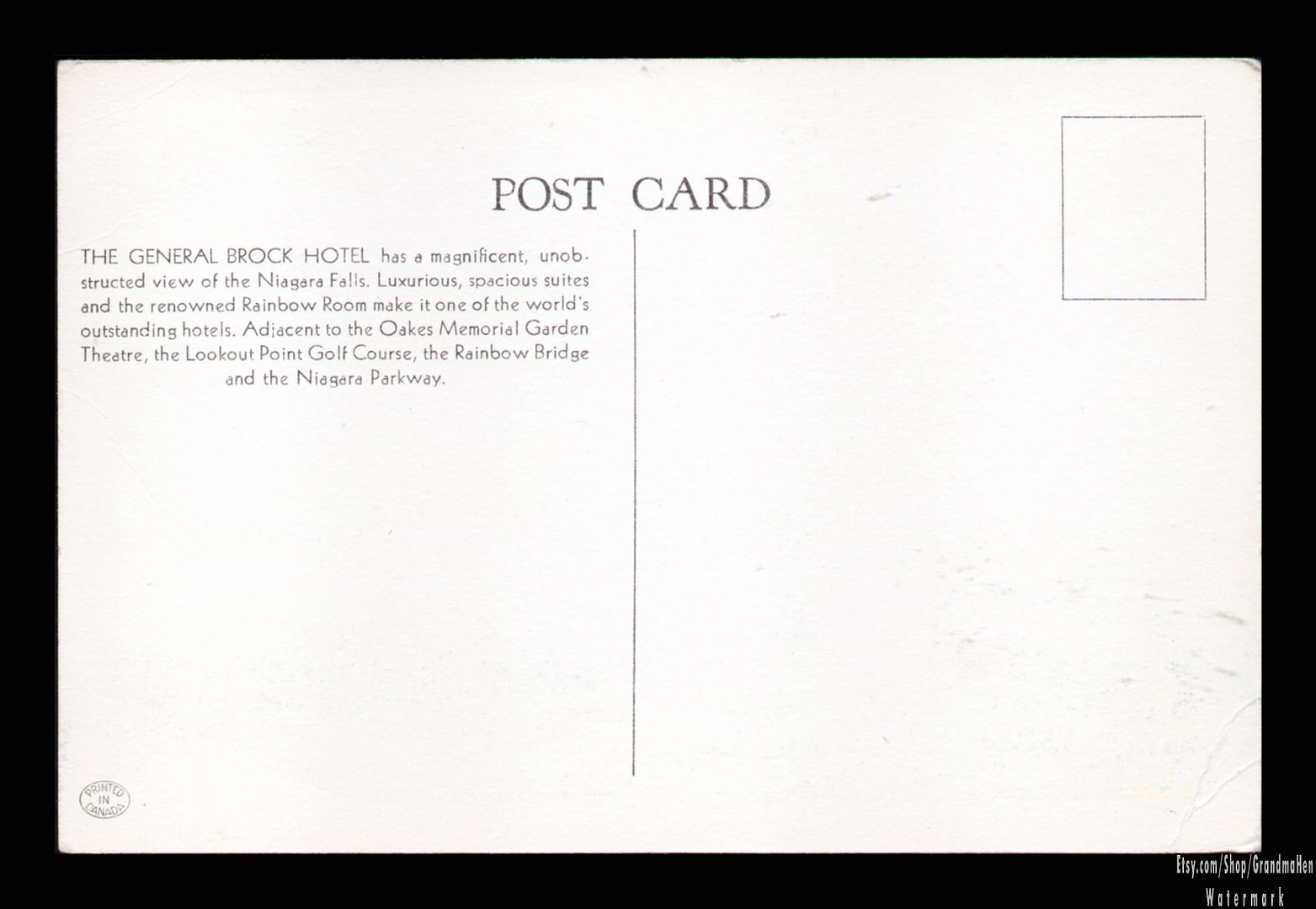
The General Brock Hotel has a magnificent, unobstructed view of the Niagara Falls. Luxurious, spacious suites and the renowned Rainbow Room that it one of the world’s outstanding hotels.  Adjacent to the Oakes Memorial Garden Theatre, the Lookout Point Golf Course, the Rainbow Bridge and the Niagara Parkway.

In January, 1929 construction began on the General Brock Hotel, the first high rise hotel on the Canadian side of Niagara Falls.  On the top floor of the eleven-story structure was the glass-enclosed Rainbow Room, a banquet hall offering a superb view of the Falls and Niagara Gorge.  

The hotel opened for business in July, 1929, after which two more floors were added to the building. Over the years many prominent celebrities stayed at the General Brock Hotel including Walt Disney, Shirley Temple, Queen Elizabeth, Marilyn Monroe, Bruce Willis and Jackie Chan. Today the hotel is known as the Crowne Plaza Niagara Falls Fallsview Hotel.

General Brock Hotel, Niagara Falls, Canada
History and Biography: Isaac Brock, War of 1812
Major General Sir Isaac Brock (1769-1812) was a British Army officer and colonial administrator from Guernsey. He became responsible for defending Upper Canada against the United States.  When the War of 1812 broke out, quick victories at Fort Mackinac and Detroit defeated American invasion efforts. 

At the Battle of Queenston Heights Brock was struck in the wrist of his sword arm by a musket ball but continued to press home the attack. His height and energetic gestures, together with his officer’s uniform and gaudy sash given to him eight weeks earlier by Teccumseh after the Seige of Detroit, made him a conspicuous target. An unknown American stepped forward from a thicket and fired at a range of barely fifty yards. The musketball struck Brock in the chest and he fell. His last words have been reported (though unlikely spoken) as “Push on, brave York Volunteers!”  The hole in his uniform suggests that the bullet entered his heart and he died immediately.

Canadians regard Brock as one of their greatest military heroes. Though not born or naturalized as a Canadian, he was voted number 28 on the television show The Greatest Canadian. 

HISTORY OF POSTCARDS AND PRINTING
The question when dating this postcard is to look at its photograph and count the floors. In 1948, two additions stories were added to the original eleven. A verification is easy to do by looking at contemporary internet photos. I found used two copies of this card for sale with postmark dates of 1949 and 1951.

The number 307 shows it to have been one card in a series. The series could have been about scenic sites in Canada or part of a souvenir set showing views of Niagara Falls. 

An interesting research project would be to look for 1948 information and photographs of Niagara Falls to put the building into the context of the time.

Looking at the scene with a magnifier tells me it is a halftone print made with little dots of color on a white background that when looked at from a normal viewing distance appears as solid color.
General Brock Hotel, Niagara Falls, Canada. No. 307. Printed in Canada

Sunday, January 1, 2017

Real Photo Post Card Man Framed with Leaf Shaped Border

Real Photo Post Card
Real Photo Post Card Man Framed with Leaf Shaped Border

Blog post by Mary Katherine May

     An interesting variation of the Real Photo Post Card is the photo portrait with uniquely shaped borders.  The one shown here is of a handsome, clean-cut man with classic features from the sometime during the first two decades of the twentieth century.

According to a MetroPostcard Guide (highly recommended site) the border shapes were created by using stencils:
LINK The most common exception to this were cards shot through a stencil to provide a decorative white border. These stencils were usually cut out of tin or heavy paper and would be sandwiched between the photo paper and negative during exposure to the sun. While these stencils could be purchased in stores and came in various designs, many forgoed the expense and made their own. Homemade stencils were rarely perfectly symmetrical and are a tell tale sign of non-commercially printed cards.
     The attractive shape, such as a leaf, apple or scroll, immediately draws the viewer's curiosity to look inside as though peering through a window.

For the collector of real photo post cards acquiring a group using different shapes might be an interesting subset group.

This particular post card has no message on its divided back, yet I feel drawn to wonder about what kind person this man was--tall or short? professional or dressed up for the photo? quiet? happy? a loner?

Details
Unused
Divided Back
Real Photo Post Card: People
AZO Stamp Box: 4 Triangles Pointing Up
Post Card as Two Words
Leaf-shaped Border


Rick and Mary May operate the webstore Quality Music and Books, and also the GrandmaHen Shop on Etsy.com. 

Thursday, December 29, 2016

PostCard Talk Real Photo Post Card Roundup Montana 1929

Roundup Montana High School (No. 45)


Vintage Real Photo Postcard

45-High School, Roundup Mont.
Blog Post by Mary Katherine May

MESSAGE
Dear Dad: We've been in Roundup about a day, and leave for coast tonight. Every one was just fine. Bessie has two children, a boy and a girl, who are very cute. Our trip here wasn't bad at all as we slept thru the plains of South Dakota and Montana. When we go to the bad lands things became more interesting. Everett.

ADDRESSEE
Mr. Edward Earsley
405 Simmons Ave.
Huron, So. Dak.

DESCRIPTION
AZO Stamp Box: 2 triangles point up, 2 triangles point down. Divided back. Used. 3.5 x 5.5 inches. Real photo Post Card (No. 45) showing a black and white photograph of the high school built in 1918 in Roundup, Montana. The much-needed high school was built due to a large increase in student enrollment.

POSTMARK
August 29, 1929
Roundup, Montana

CANCELLATION
7-Wavy Bar Killer


HISTORICAL CONTEXT
The U.S. Stock Market reached its peak in August of 1929 before collapsing in October issuing in the Great Depression.

On Thursday, August 29, 1929, the Graf Zeppelin completed its round-the-world trip back where it started in Lakehurst, New Jersey.

The Story: Everett and Edward Earsley
 A divided back post card written by son, Everett Loyd Earsley to his dad, Edward Earsley in Huron, South Dakota.  Although Everett doesn’t write his surname it is a good assumption to think that his last name is Earsley.

Although difficult to read the postmark because of the written message, a close look reveals it to have been sent from Roundup, Montana on August 29, 1929.

Everett is on a trip with others, maybe by train, making a stop in Roundup on the way to the coast.  Not much attention was spent looking at scenery except for the Badlands, and maybe for good reason as it is said that the plains of Midwest America is one long wave of amber grain.

We cannot know, but perhaps this was vacation taken as the last hurrah before entering the dental school at the University of Minnesota in September.  Graduating in 1932, Dr. Earsley set up a dental practice in Winona, Minnesota, with fellow graduate, Dr. Paul Pettit of Minneapolis, Minnesota.  He served as a dentist in the U.S. Army during World War 2.

Earsley was the only child of Edward and Sophia Sonnenberg Earsley, born in Winona.  As this Earsley family began and ended in Winona, the post card, addressed to Huron, South Dakota, was perhaps where they were living because of a job transfer since Edward was employed by the Chicago & North Western Railway.

Dr. Everett Earsley died in 1997 at the age of 90. 

Friday, November 21, 2014

Jesse James Centenary Numbered Mourning Cover 1982

Jesse James Centenary Mourning Cover
Numbered 232/500
Jesse James Centenary April 3 1982
Postal Cachet
Created by Richard T. Crowe
Numbered 232/500

This blogpost article by Mary Katherine May of QualityMusicandBooks.com

Because of my interest in mourning covers at some point in time I acquired the cachet shown here issued as a commemorative in a numbered quantity by Richard T. Crowe. The cover I have is number 232 of 500.

It seems a little odd to me, however, that since I am ready to sell it, I cannot find another on the internet for sale which poses a problem for me since I have nothing to upon which to base my price.  Generally speaking, this is not a necessarily unusual except that the field of postal cachets in not my field of expertise. I collect, but not in great numbers or great prices.

Jesse James Centenary Cachet Postmarked April 3, 1982 in Saint Joseph, Missouri
Artist: Richard T. Crowe
Stamped [Signed] by Richard T. Crowe
Limited Numbered Cachet: 232/500


Jesse James fascinates many Americans, as he evidently did Richard Crowe.  The cachet itself has the marks of being done well but not perfectly.  Though the Remington stamp appears square to the eye, the 2 cent stamp does not. Looking not too carefully at the black mourning border, it looks to possibly have been marked by hand because of the uneven color and spots outside the border.

Posted on April 3, 1982, in Saint Joseph, Missouri, the stamp mark is clear, large, and readable.  The quotes and remarks tell us the sentiment of Crowe toward James, calling him the American Robin Hood, and that he stole from the rich to give to the poor.

Most likely the creator of this Jesse James centenary mourning cover was Richard T. Crowe of Chicago, Illinois, who was known for leading ghost tours in his city.  Crowe also was a deltiologist or postcard collector who had a special interest in the Old West. It is reported that he names his cats Jesse and Frank after the James' brothers.

Link to Chicago Sun Times article about Richard T. Crowe on the even of his death.

Sunday, November 2, 2014

Lewis Lice and Fly Destroyer Company Old Mail Shows Interesting Trademark Logo

Trade Mark log for Lewis Lice and
Fly Destroyer Company
Entered in the U.S. Patent Office June 9, 1913
Postal Ephemera
Agricultural Ephemera
Maine and Massachusetts Business History

This blog post article by Mary Katherine May of QualityMusicandBooks.com.


If you are interested in ephemera and postal items in particular, you will have particular elements that will peek your interest while browsing antique stores, thrift shops and online sites that sell such items.  It was the image on this particular item, though not a postcard, that first caught my attention.


The Trade Mark logo with a framed photo inset bordered with a cow head, horse head and chicken actually makes me smile because for some unknown reason that without doubt made good sense at the time now in the 21st century I think has humor.


George W. Lewis and Son

Lewis Lice and Fly Destroyer
George W. Lewis and Son was a successful business operating in Westboro, Massachusetts, which on June 9, 1913 filed this Trade Mark with the U.S. Patent Office for the Lewis Lice and Fly Destroyer Company. LINK

The logo image makes sense, since we get an immediate visual picture of what animals will benefit from this particular product that kills lice and flies, and more. The portrait of George Lewis and his signature lends authenticity and recognition of a man who stands behind his product.

Postal History from 1913
We might question, however, how a product patented in 1913, the same as the postmark year on the envelope, can have experienced 12 years of wonderful success as stated, but perhaps Mr. Lewis was just a little slow in registering the product he had been selling for quite some time.

Opposite the above claim we read that the product is perfectly harmless, no dangerous effects if the animals lick it, which animals will do.  Was this claim true?  According to the Annual Report of the Maine Agricultural Experiment Station in a general statement for this and similar products,  LINK

"They are very much alike and depend upon a mixture of vegetable oils, hydrocarbons from petroleum, crude petroleum and coal tar derivatives for their repelling power."
A Lewis Company ad in the Marion Star, Marion, Ohio, June 21, 1913, promises a money back guarantee if not satisfied along with the following: 
"We guarantee that this Lice and Fly Destroyer will kill flies on cows and keep them off all day; cure barn itch and cure cattle lice.  Also body lice on poultry and mites in poultry house.  When used as directed.  If not return empty can and get money back.  You Dairymen—come in and let us tell you how a can or two of this Fly Killer will increase your herds flow of milk during the summer.  It’s sold quart, half gallons and gallons."
Ammi Whitney and Hosea Kendall formed their partnership in 1858, and had run successful agricultural business in Portland, Maine for over fifty years at the time this envelope was posted in 1913.  LINK 1.     LINK 2.

Ammi Whitney

Hosea Kendall
My research turned up very little on Mr. Kendall, but I found some interested information on Ammi Whitney of which I offer a portion here along with a link to the source.

Ammi Whitney (1833- ) was an infant of six weeks when his parents removed to Falmouth. He remained on the farm until twenty years of age, in the mean time acquiring a fair education in the common schools of the town. He then went to Boston and entered the employ of the old firm of Parker & White, dealers in seeds and other agricultural goods. He spent nearly six years in this employment, returning to Portland in 1858, and forming a partnership with Hosea Kendall in the same kind of business.


Essentially a self-made man, he has attained prosperity by the exercise of natural business talent, a conservative judgment, and a scrupulous probity in business as well as in all other relations. LINK.

Though I cannot say for certain, it is my thought that George Lewis would have paid to have his product advertised on Kendall and Whitney stationery--a good marketing tool for all and revenue for Mr. Kendall and Mr. Whitney.  

Postal Marks
Regarding the stamp, postmarks and postal killer, there is nothing unique or special about them. There are two postmarks, one at point of sending and on the envelope back side one at point of receiving.  The blue date stamp on the front most likely was stamped upon J.L. Chick receiving his mail, which is a common office method of documentation.

Source: Portsmouth Herald, Portsmouth NH, 15 January 1951

Joshua L. Chick
Chick Farm
Wells is about 33 miles south of Portland, and the location of Chick Farm run by the Chick Family. Joshua Chick, or J.L. Chick as addressed, was the proprietor of a agricultural or general store, depending upon what information you look at.  It seems that Joshua L. Chick never married and was at some point a municipal officer of his city in the capacity of Justice.  He lived 78 years, which was a good, long life in the first half of the 20th century. LINK.

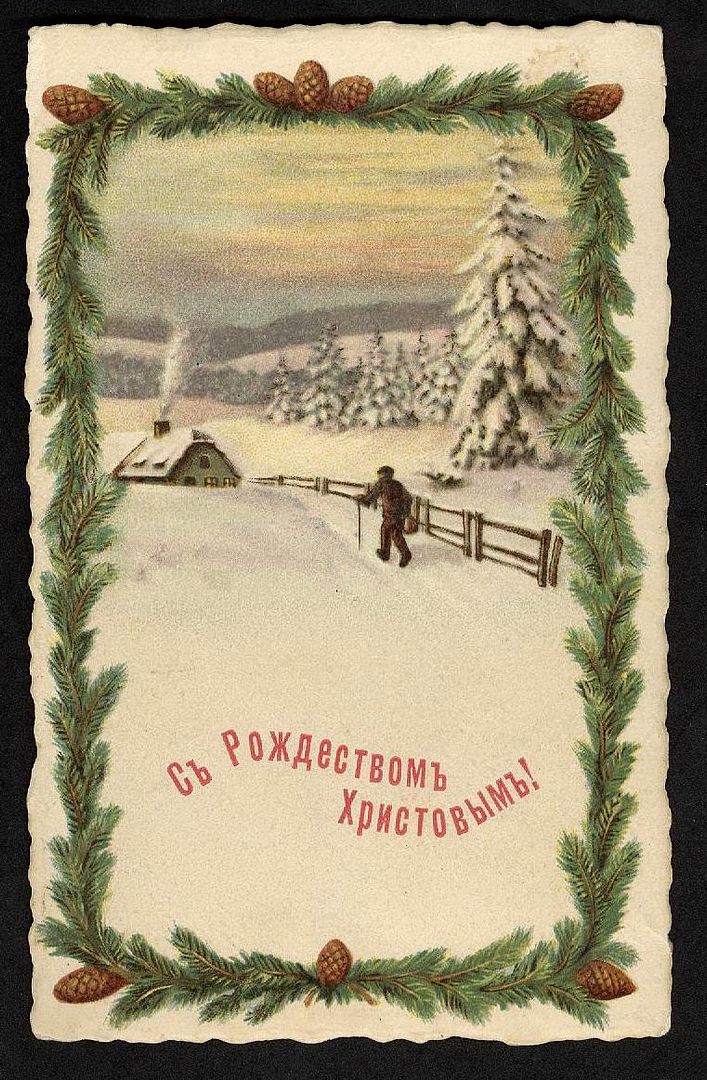
Missionary Rev August Lindstedt 1923 Christmas Greetings Harbin Manchuria China

Christmas Greeting in Russian Language
sent to a Swedish Baptist Missionary in
Manchuria, China.
Vintage Postcard: Christmas 1923
Manufacture: BNK
      (who knows about this company?)

This blog post article offered by Mary Katherine May of QualityMusicandBooks.com.


Sometimes a postcard comes your way that sparks great intrigue, and this is one such postcard. Let's take a look with what we have to work with.


1. A man walking at a good pace over snow-covered ground toward a cheery looking cottage with smoking from the wafting into the wind.


2. Well-shaped fir trees blanketed in white.


3. A distant horizon under a soft, glowing sky that adds expanse to the small illustration.


4. The first hint of the holiday is found in the garland scattered with pine cones bordering the scalloped, rough edges of the card. They look blue-green in color to me--spruce, perhaps?


5. A Christmas greeting in the Russian language printed in red, and now the two traditional colors are present.


Truly, an International Postcard

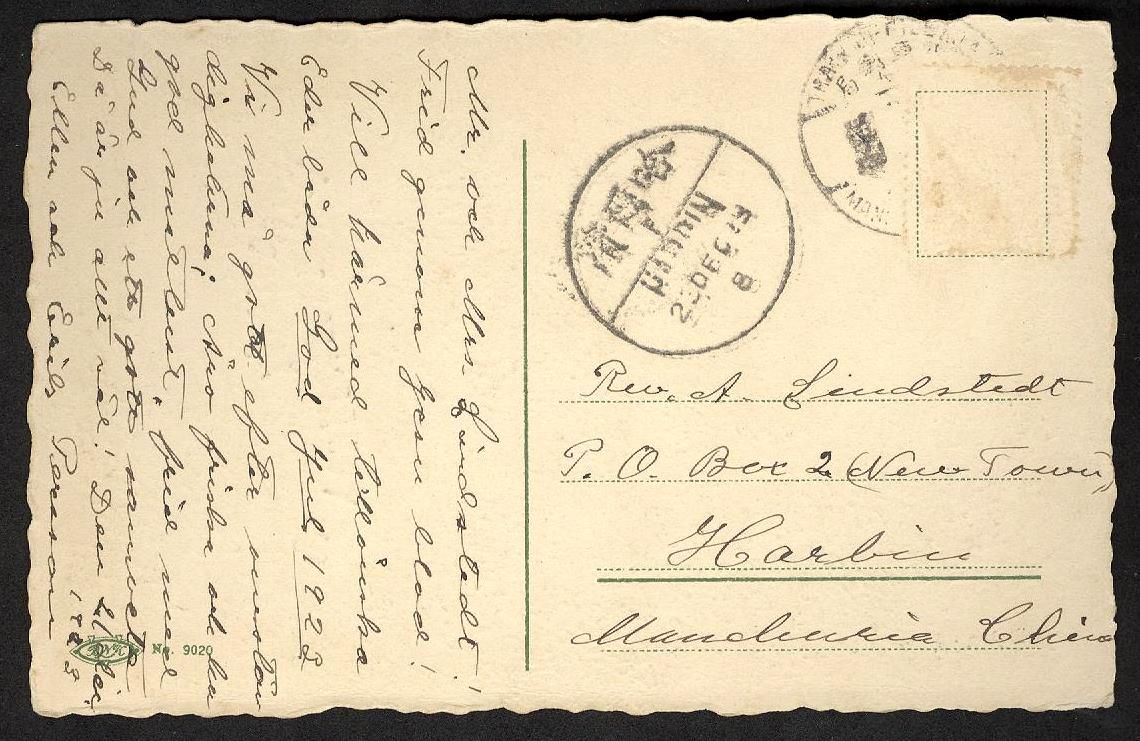
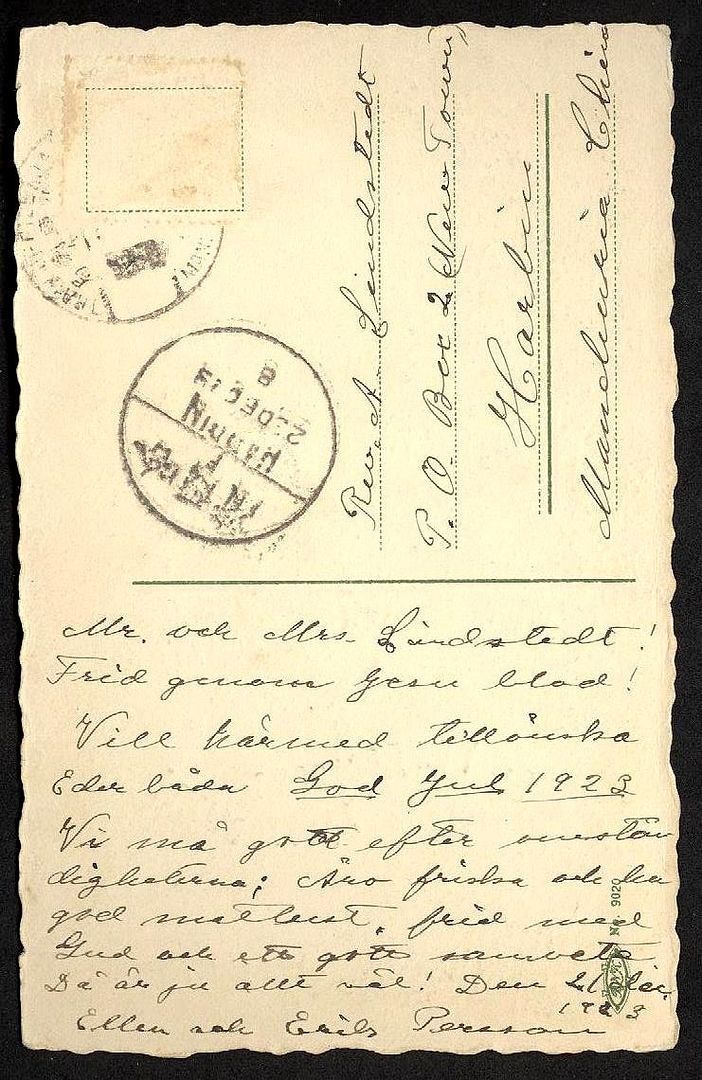
Turning the card over--and this is SO exciting--is the message written in Swedish. Trying a translation tool won't help because I can't make out what it says except for God Jul 1923, and the signers, Ellen and Erik Persson.

But wait! There is more! The postcard is addressed to Rev. A. Lindstedt, P.O. Box 2 (New Town), Harbin, Manchuria, China.


Russia, Sweden, China: It All Comes Together

There is not a great wealth of information on the internet about Rev. Lindstedt, yet what is available offers an amount sufficient to understand what a brave undertaking the Reverend and his family did through the strength and grace of God.


Message to Rev. August Lindstedt from Ellen and Erik Persson, mailed to Manchuria, China
Unfortunately for us, we can see that the postage stamp has been removed.
More Information
August Lindstedt and his family served as missionaries of the Swedish Baptist General Conference in Vladivostok from 1916 to 1917, and among Russians in north China and Manchuria from 1917 to 1946. In the early 1920s Conference assumed control of the Chicago-based Swedish Baptist Foreign Mission Society brought to culmination agitation - and practical efforts that had extended over more than three decades. Earlier grassroots support through the Nya WeckoPosten thus became recognized support of the Lindstedt family in Siberia and China.

God Jul 1923 from Ellen and Erik Persson
to Mr. and Mrs. Lindstedt.
Rev. August's son, Marvin offers a short, well-written article on the work of the Swedish Baptists in China in an edition of Trail Markers, a Bethel University publication.  I quote a brief passage here:

E. W. Olson was an East Coast Conference pastor who had once been to Siberia and wanted to return as a missionary to the Russians. Olson had friends in Sweden, and traveled there to try to stir up interest and financial support for the work he envisioned. In Sweden, Olson met and recruited August Lindstedt, a young Christian who believed that God wanted him to preach the good news of salvation to Russians.

Update Reports in the U.S.A.
When missionaries to foreign countries are here in the U.S. on sabbatical or other reasons, they frequently give talks at church functions to report on their progress and help raise money for their work. Contributing to the support of missionary work is a way for all Christians to be a part of Jesus Christ's Great Commandment in Matthew 28:19-20. 

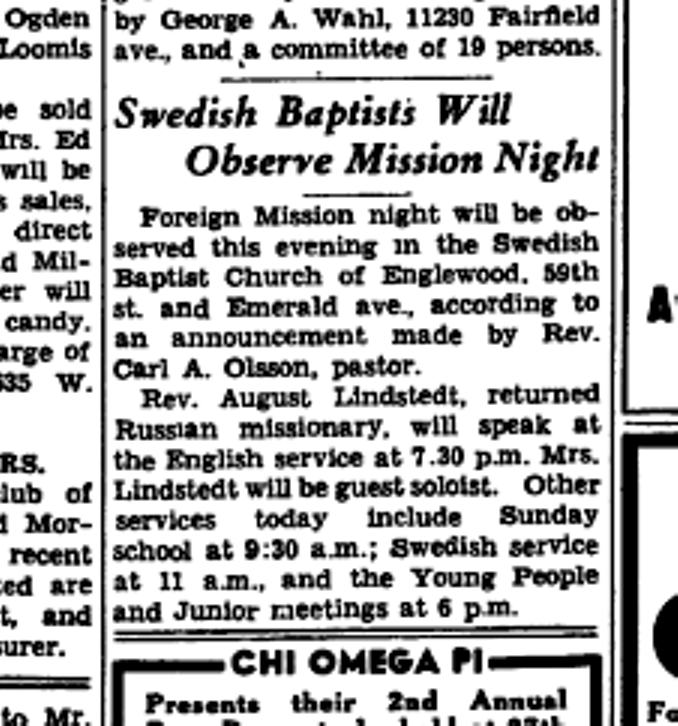
Here is a newspaper clipping announcing an upcoming talk by Rev. Lindstedt from the Southtown Economist, Southtown, Chicago, Illinois, October 23, 1938.

Announcement of Rev. August Lindstedt  upcoming talk.
Mrs. Lindstedt was guest soloist.


Missionary Life
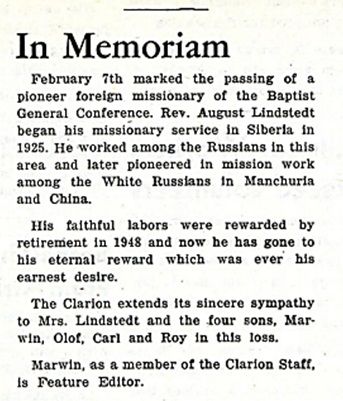
The Clarion, Bethel College and Seminary's newspaper, in the February 1950 issue gave report of Rev. August Lindstedt's entrance into the the blessed rest of the Lord. Missionaries, in this case a husband and wife and their family, often live a hard life out of love for the work they do, and health is often compromised in the course of their efforts. This ends my brief account of how much can be learned from one small postcard with a Russian Greeting, a message written in Swedish, and sent to the Russian enclave in Harbin, Manchuria, in December of 1923.


Wednesday, March 19, 2014

1890 Fenley Edmunds Letter Old Colony Train Wreck Quincy MA

Adressee: Mr. W.C. Fenley, Quincy, Mass.
September 11, 189
A short letter to Quincy, Massachusetts sent from cousin to cousin is not what it first seems.
by Mary Katherine May

THE LETTER (introduction): Historical Facts versus Assumptions
I recently purchased this letter while on a short trip into southwestern Wisconsin.  On first reading, I thought the note, written to William Fenley by his cousin William Edmunds is bland and chatty.  I wonder if maybe Edmunds’ words are rather bold, perhaps looking for a return on the money paid out upon receipt of the second trunk from Quincy, Massachusetts.  I was wrong.

THE LETTER: Transcription
To Mr. W.C. Fenley, Quincy Massachusetts

Stationery: Citizens National Bank, Louisville, Ky.
September 11, 1890

Dear Cousin Will:

Mother asked me to write and let you know the other trunk had arrived.  It came by the American Express last evening, and the charges were not prepaid, as the other had been which came over another line—the Adams.  I merely let you know this so that if any mistake has been made, it may be corrected at once.  We are very quiet here and there is no news to write.  Mother and Aunt Ruth have gone out to your place for the day.  We have had a real hard rain and everything is fresh this morning.  Write us when you can do so, as every word from you is of great interest to us here.

Yours,
Wm. Edmunds.

THE TRAGIC STORY
William Carr Fenley, the first of five children born to Oscar Fenley and Mary Elizabeth Carr Fenley, was in Quincy because six family members including his daughter Susan, his mother Mary Elizabeth and sister Mary Lewis were killed less than a month earlier in what is known as the Old Colony Train Wreck that tragically took 22 lives. I believe the Fenley family had been seated in the fourth car of the train, which in the wreck had been forced up and over the engine.  The boiling hot steam from the engine filled the car above scalding everyone inside.
The Fenley Family Members Who Lost Their Lives 
Mary Elizabeth Carr Fenley, mother of 5 children including Mary Lewis, William C. and Oscar
Mary Lewis Fenley Abbott, wife of William Abbott
Alice Rosebrook Short Fenley, wife of Oscar
Susan Hannah Fenley, daughter of William Carr and Frances Marion Williams Fenley
Mary Katherine Fenley, daughter of Oscar and Alice Fenley
Alice Short Fenley, daughter of Oscar and Alice Fenley
The Fenley Survivors
Two of the Fenley party on the train survived: William Abbott, husband of Mary Lewis Fenley Abbott, and Elizabeth, daughter of Oscar and Mary Elizabeth. Both had been badly burned.  

Oscar Fenley, brother of letter recipient William Carr Fenley, stayed in Quincy until his daughter Elizabeth recovered sufficiently to travel. I don't know if his brother William to whom this letter is addressed remained the whole time but it is likely that he did. Two months after the wreck Oscar brought his family home to Louisville to be buried.

The Trunks Shipped to Louisville
The two trunks shipped to Louisville about which William Edmunds wrote were the belongings of the deceased. 
Letter to William Carr Fenley from cousin William Edwins dated September 11, 1890
WILLIAM EDMUNDS (1862-1912)
William Edmunds’ relation to the Fenley family is through his mother, Martha Gaither Carr Edmunds (1827-1911), one of seven daughters born to Captain John Carr and Mary Gaither Carr, and sister to Mary Elizabeth Carr who died in the Old Colony train wreck. Aunt Ruth mentioned in the letter is also a sister. Captain John Carr fought in the war of 1812.

Postal Information


I am not an expert on postal cancellations and so I offer little information in this respect, leaving it for others to decipher.  The envelope has two postal cancellations: Quincy, Mass. on the back dated possibly September 13, and Louisville, KY. on the front with an oval boat shape bar killer inset with the number 2. The postage is a prepaid 2 cent green Washington.  


References
Mary Elizabeth Carr Fenley with links to other family members on FindaGrave.com
William Edmunds on FindaGrave.com