Showing posts with label Mary Katherine May. Show all posts

Thursday, January 26, 2017

What About That Wartburg Seminary Building in 1889?

Wartburg Seminary Building
F. Louis Egelhof Postcard
Wartburg Seminary Building
Dubuque, Iowa
Hand-painted Postcard

Photo by F.L. Egelhof, 1907
Publisher: B.B. Co., Printed in Germany


Blog post by Mary Katherine May

First Impression
My first impression of this antique postcard was the beauty of the hand painting that added color to the photograph by F. Louis Egelhof.

F. Louis Egelhof
Frederick Louis Egelhof bore the same name as his father and followed him into the mortuary business in Dubuque, Iowa. Born and baptized in 1885, Lutheran baptismal records show his name as Friedrich Ludwig Egelhof.

Egelhof was also a photographer who created post cards depicting scenes of Dubuque. These may or may not have been done for promoting his business, we don't know. Even without the copyright date the fact that this postcard was printed in Germany tells us that it dates to before the outbreak of World War I. Egelhof died in 1953.


Who Was J.T.O.?
Notation to back: This was Wartburg Sem. where I got my theological training 1910-1913. J.T.O.

Very Brief History of Wartburg Theological Seminary
Wartburg Seminary had its beginnings in Saginaw Michigan in 1852 when Lutheran missionaries from Bavaria opened a teacher training school. The school went through moves to several locations for financial reasons and growing enrollment, including to Dubuque, Iowa in 1853 where they remained for four years. In 1889 Wartburg Seminary returned to Dubuque and settled on thirty acres, the old Emerson estate, gifted to them by the city by the Board of Trade. With an expanding student body, new buildings were added and dedicated in 1916.

Dubuque Second Time Around
The Wartburg Seminary Building, an enlargement of the Emerson homestead, was dedicated on September 17, 1899.

Surprisingly Little Information
The question at hand for us is the origin of the building as shown on the postcard by F. Louis Egelhof, and for this I offer several accounts from documents of the period. As a general rule, educational institutions offer on the internet a great deal more historical information than is available for Wartburg Seminary, and I am surprised that I could find so little, even on their website. As a matter of fact, I found no resource telling me whether or not this building still exists.


Wartburg Seminary, Dubuque, Iowa 

What We Know or Think We Know
1. 30 acres were donated to the German Lutheran Church in America by the city of Dubuque Board of Trade.
2. The 30 acres at one time were owned by people with surname Emerson.
3. The Emerson property was a homestead.
4. Wartburg Seminary Building was an enlargement of the Emerson homestead.
5. 20,000 or 25,000 dollars, or some amount was spent on buildings.

Source One
The Lutheran Cyclopedia edited by Henry Eyster Jacobs, D.D., LL.D. and Rev. John A.W. Haas, B.D. New York: Charles Scribner’s Sons, 1899. (selection from entry)
Wartburg Seminary: But when, after the lapse of 16 years, the increasing attendance imperatively demanded more spacious quarters and the city of Dubuque, Ia., made a very liberal offer, the seminary was removed to its starting-point, and the four buildings occupied at present put up at an expense of $20,000.
Source Two
Wartburg Seminary Dedication Day
Wartburg Theological Seminary Dedication Day
San Francisco Chronicle, Monday, September 16, 1889.
German Lutherans. Dedication of Their New Theological Seminary.

Dubuque (Ia.), September 15. The dedication of the new Wartburg Theological Seminary of the German Lutheran Church took place in this city today. Ten excursion trains brought thousands of people from Iowa and Illinois. Several thousand people from Dubuque were also in attendance. The seminary grounds, comprising a beautiful estate of thirty acres west of the city, are a gift to the synod by the citizens of Dubuque.

     The dedication ceremonies occupied the entire day. The main seminary building was erected at a cost of $25,000, and has accommodations for 125 students. The Wartburg Seminary is the main theological school of the German Lutheran Church in America. All candidates for the ministry of the church from the synods of nine States must get in it their theological education.

Source Three
Pittsburgh Daily Post. Monday, September 16, 1889. (selection for news article)
Wartburg Theological Seminary.
Dubuque, Ia. September 15. The dedication of the new Wartburg Theological Seminary of the German Lutheran Church took place in this city today. The dedication ceremonies occupied the entire day. There was preaching in both English and German, and singing by a choir of 500 voices.
Source Four
A Narrative History of The People of Iowa by Edgar Rubey Harland, LL. B., A.M. The American Historical Society, Inc., Chicago and New York, 1931.
     A few years after its founding Wartburg, for financial reasons, was moved to Clayton County, in the community known as St. Sebald, founded by friends of the school. Here the institution grew substantially, and with funds collected in the Baltic provinces of Russia in the early '60s by the late Dr. Sigmund Fritschel, then president of the seminary, the financial condition of the Wartburg was materially strengthened. 

      By 1874 the early storms had all be weathered, and Wartburg was permanently established as an integral factor in the expansion of the Lutheran Church in the Midwest.
     The enrollment by that year had outgrown the limited capacity of the plant at St. Sebald. A large building at Mendota, Illinois, was taken over and Wartburg again became an urban institution. Soon the enrollment, made up of both American students and students from Europe, had again doubled.
     About this time the Dubuque Board of Trade offered the old Emerson Estate on the southwestern outskirts of the city to Wartburg, provided the property be improved and devoted to educational purposes. On September 17, 1889, the old Wartburg Seminary Building, being an enlargement of the old Emerson homestead, was dedicated.

     Soon after the removal of Wartburg back to Dubuque the immigration of students from Germany and other foreign lands began falling off. Today the enrollment consists practically entirely of American born students, graduates of American colleges and preparatory schools. Only graduate students are now enrolled in the Seminary.

Resources
Information for this blog post came from Newspapers.com, Ancestry.com, and Google searches.

About the Blog Author
Mary Katherine May and her husband Rick operate Quality Music and Books, an internet webstore, and the shop GrandmaHen on Etsy.

Friday, January 13, 2017

1878 Antique Postal Card UX5 One Cent Liberty International Order of Good Templar Mauston

1878 Postal Card
I.O. of G.T. International Order of Good Templar 
Mauston Wisconsin 1878
Preprinted Postal Card: UX5 One-Cent Liberty
Cancellation: Mauston (Juneau County), Wisconsin, June 6 or July 6.
Size: 3 x 5-1/8 inches

Addressed to: Robert Glenn, Jr., S.D., Wyalusing, Grant County, Wisconsin.

MESSAGE
A receipt for payment message sent by the I.O. of G.T., Grand Lodge of Wisconsin by B.F. Parker, Grand Worthy Secretary.

I.O. of G.T. Grand Lodge of Wisconsin
Office of Grand Worthy Secretary, Mauston, Wis.
Robt. Glenn Jr. L.D. No. 199

Your Report for Quarter ending April 30, 1878, and G.L. Tax amounting to $4.32 is received.
B.F. Parker, G.S.


Receipt for Payment from the International Order of Good Templars, a temperance organization
DETAILS
Used Postal Card with Town Cancel on Preprinted UX5 Liberty one-cent Postal Card, black on buff, issued in 1875. Variations apply to this UX5 Postal Card: No watermark, and on front: Write the Address on This Side. It was mailed to Robert Glenn, Jr., S.D., in Wyalusing, Grant County, Wisconsin.

CANCELLATION and DATE of MAILING
The postal card uses a Town Cancel with no year. The 1-cent Liberty printed postage shows no killer mark.


HISTORICAL CONTEXT

Addressee: Robert Glenn, Jr., (1858-1915), husband of Hattie (Harriet E. Brodt) and father of many children, was a farmer. He was elected to the Wisconsin Senate in 1912 representing the sixteenth district. Additionally, Glenn was Sheriff (1905-1906) of Grant County, Wisconsin and a member of the Grant County Board. He was a Republican.

Organization: I.O. of G.T. is a worldwide International Order of Good Templars, now known as the International Organisation of Good Templars, whose purpose is the promotion of alcolhol-free, drug-free, good living. The first Wisconsin lodge in Sheboygan Falls was organized in 1854. A Grand Lodge for Wisconsin was instituted on May 13, 1856, with F. A. Atherley as G. W.C. T. and Seth C. Buckman as G. W. S. By 1860 the Wisconsin membership totaled 12,000 in 152 Lodges.

Grand Worthy Secretary: Benjamin F. Parker (1839-1912) came to Wisconsin from Pennsylvania in 1853 where he apprenticed Waukesha, training for the profession of carpenter.  When the American Civil War broke out he enlisted and served in Company K of the Second Wisconsin Volunteers and Company A of the First Wisconsin Volunteers, Heavy Artillery Division. When mustered out in November, 1865, Parker had attained the rank of Senior First Lieutenant. He then settled in Mauston where he was in the furniture business, married and raised a daughter, and was active in the I.O. of G.T. and Ancient Order of United Workmen.

Blog post by Mary Katherine May.
Rick and Mary May operate the Etsy.com shop GrandmaHen and the webstore Quality Music and Books.

Thursday, January 12, 2017

Real Photo Postcard 1936 Indian Home Ojibwe Wigwam Mille Lacs Minnesota

Blog post by Mary Katherine May

Here is a real photo postcard I found with the caption Indian Home Mille Lacs Lake, Minn.  It's a little dark because of the shadows from trees when taken and probably some from age. 


The photo is of a dome-shaped Ojibwe wigwam with cattail mat sides and roof of overlapping animal hides. Scene includes two children and seated woman. A cook stove is situated to the right.

Ojibwe Wigwam, Mille Lacs Lake, Minnesota
Real Photo Postcard dated July 4, 1936.

 
EKKP Stamp Box and Written Date
   Very helpful for the collector and historian is the date penciled on the back: July 4, 1936.  This is verified by the EKKP stamp box that was in use 1904 to 1950.


     Mille Lacs Lake has been a popular northern Minnesota vacation spot where people enjoy outdoor sports as well as activities at Grand Casino Mille Lacs owned by the Mille Lacs Band of Ojibwe. For those who don't go for the gaming there are concerts and a fabulous buffet.


     The Ojibwe have lived in the area around Mille Lacs Lake since at least the mid-1700s. Because of settlers wanting the land and the introduction of infectious diseases by the end of the nineteenth-century only a few hundred Ojibwe remained in the area. 

     During the 1930s Mille Lacs Band children were sent to boarding schools with the government’s intent being assimilation into mainstream American society. To that end the children were not allowed to speak their Ojibwe language. 

     In 1934 with passing of the Indian Reorganization Act that recognized the Indians’ right to self-government, six Ojibwe bands, including the Mille Lacs Band, joined together to form the Minnesota Chippewa Tribe. In the early 1990s, the Band opened Grand Casino Mille Lacs and Grand Casino Hinckley. Since then, casino revenues have allowed the Mille Lacs Band to strengthen its cultural identity, return to economic self-sufficiency, rebuild its reservation, and increase the prosperity of the entire region. (Sources: MilleLacsBand.com; Wikipedia.org.)

Rick and Mary May operate the webstore QualityMusicandBooks.com and on Etsy, GrandmaHen's Treasure Shop.

Wednesday, January 4, 2017

The Twin Mountain House New Hampshire Vintage Postcards and American History

Twin Mountain House, New Hampshire
Vintage Postcard ca. 1943-1960
The Twin Mountain House
Twin Mountain, N.H.

Details
Vintage Divided Back Postcard
Eagle Post Card View Co., New York 1, N.Y.
Photo Duo-Tone

3-5/8 x 5-5/8 inches

Blog post by Mary Katherine May.

Dating the Post Card
One of the first orders of inquiry for a deltiologist is dating the postcard. This can be done by type of paper and printing, the stamp box, how the back side is arranged, and also by ascertaining when the manufacturing company was in business.

For this postcard I used the caption on the front as a clue: Eagle Post Card View Co., New York 1, N.Y. The 1 is a postal zone number used by the United States Post Office from 1943 to 1963, after which the ZIP Code was introduced. The ZIP being an abbreviation of Zone Improvement Plan.

According to the website OldStuffOnly.com, the zones were started in 1943 during World War 2 to aid all of the newly employed postal clerks who replaced the men now in military service. In 1963 the United States Post Office began using a 5-digit Zip Code. The ZIP is an abbreviation of Zone Improvement Plan.
Twin Mountain House Vintage Postcard Back

Twin Mountain House is no longer in operation. The Mount Washington Hotel at Bretton Woods is one of the few grand hotels remaining. In the publication Field Trip Stop and Drive-by Site Descriptions, 64th Highway Geology Symposium, North Conway, New Hampshire, 2013, there is a fabulous image of the Twin Mountain House viewed from across the Ammonoosuc River (p. 71) and the dates of 1868-1960 are given as years in operation. This allows me to date the postcard between 1943 and 1960.

Twin Mountain House
The Twin Mountain House in Twin Mountain, New Hampshire, was one of many lodging places where people would come for a visit or a season to get away from the heat, noise and dust of city life.  The air in the mountains allowed relief from hay fever.  

The post card back describes the excellence of the Twin Mountain House: 
A landmark hotel of distinction... The utmost in comfort, good service and unsurpassed cuisine.
Henry Ward Beecher spent many seasons at the Twin Mountain House where he offered daily morning devotions and Sunday sermons as well as comfort and counsel to the resident lodgers, or as one publication called them, inmates. Beecher's sister, Harriet Beecher Stowe, author of the pre-Civil War novel Uncle Tom's Cabin, also visited the House, as did many prominent people. Notices were placed in newspaper's announcing their impending plans to visit.

Historical Source 1: Twin or Not a Twin?

Selected Text:
The Twin-Mountain House is on a little terrace north of the Ammonoosuc River, and in the vicinity of a group of saw-mills. It is provided with post and telegraph offices, billiard and bowling rooms, and croquet-grounds; and keeps a band during the summer.  It is equal to the Glen House or Bethlehem as a refuge for people affected by hay-fever, though it is much lower than either of those points.

The house was built in 1869-70.

The view from the Twin-Mountain House includes on the left the symmetrical knolls known as the Sugar Loaves (and sometimes locally called the Baby Twins), on whose right is the massive Mt. Hall.


The Twin Mountain House, Twin Mountain, N.H.
Food better than the view?
The situation of the Twin Mountain House was not well chosen, with reference to mountain-views, but its cuisine is justly celebrated; and to the usual amusements of a summer-hotel it adds the pastime of boating, on an adjacent mill-pond of considerable length.

The people about the house stoutly maintain that the two mountains nearly opposite are the Twin Mountains, but they are not, since the Twins lie in a line nearly North and South, and the North Twin only is visible, Mt. Hale being the other “Twin” (as regarded by the hotel people).  The Twin Mountains are seen from Mts. Washington and Lafayette, and other points East or West of their line, but not from the Twin-Mountain House.

Historical Source 2: Building and Location

Selected Text:
Oscar and Asa Barron, brothers, largely identified themselves with the building up of the hotel business of the western side of the White Mountains, and did much to develop summer travel.  Both were active and energetic men, and were connected with the erection and conducting of the Twin Mountain House, Fabyan's, Mt. Pleasant House, Crawford's and the Mt. Washington Houses. Both are now dead. Col. Oscar G. Barron is their successor.

Twin Mountain House takes its name from two prominent peaks of the Franconia range.  This house is well known as a quiet, secluded mountain retreat, and a pleasant resting-place for invalids.  It was built about 1870, stands upon a terrace, faces east, is surrounded by ornamental grounds, and has room for 300 guests.  The boating on the mill-pond is very enjoyable; the cuisine is excellent, and this hotel well merits the favor it meets with the travelling public.

The Twin mountains are nearly 5,000 feet in height, and from the northern summit can be seen a vast panorama of valleys, highways and villages; on the west the Presidential range, and eastward, the Connecticut valley, while on the south an almost boundless stretch of craggy and wooded mountain forms a pleasing variety to the views.

Historical Source 3: Twin Mountain House and Henry Ward Beecher
Source: Pinehurst Outlook, Pinehurst, North Carolina, 14 January 1898. (Newspapers.com clipping)

Selected Text:
Henry Ward Beecher: The Celebrated Plymouth Pastor’s Summer Parish. Services conducted by him in the parlors of the Twin Mountain House. Interesting Recollections of his special reporter, T.J. Ellinwood.

For a number of seasons it was my pleasant duty to report the discourses of Mr. Beecher at the White Mountains. During a large portion of his vacations he preached regularly on Sundays at the Twin Mountain house, whither he resorted from year to year on account of hay fever, with which he was afflicted. The services were generally held in the great parlor of the hotel, and were so largely attended that many were obliged to occupy seats or standing-room in the halls or on the piazzas. A part of the time the accomodations for the audiences were so inadequate that an immense tent was procured under which the services were held.

In addition to his Sabbath discourses Mr. Beecher gave to guests of the hotel week-day morning talks, which were very much prized, and were often attended not only by the inmates of the Twin Mountain House but also by people from a distance.

We had there a good many people of the world, who were not habitual attendants at church, because, as they said, religion was ordinarily presented in a way that violated their common sense, their observation, and their highest reason.  I have ground for believing that there were some among them who entered into the Christian life under the influence of the preaching in the parlors of the Twin Mountain House.

Which Twin Mountain House?
Source: The Brooklyn Daily Eagle, Brooklyn, New York, 12 June 1904 (Newspapers.com clipping)

Imagine my surprise when I looked at what I thought was the only Twin Mountain House that could house at least 200 and saw a structure that appeared it could hold at most maybe 40 people?

The confusion cleared quickly when I realized the Twin Mountain House I was looking at was in the Catskill Mountains in New York that was in operation the same time as the one in New Hampshire.
Twin Mountain House in the Catskill Mountains
From the Pinehurst Outlook, 1898


Tuesday, January 3, 2017

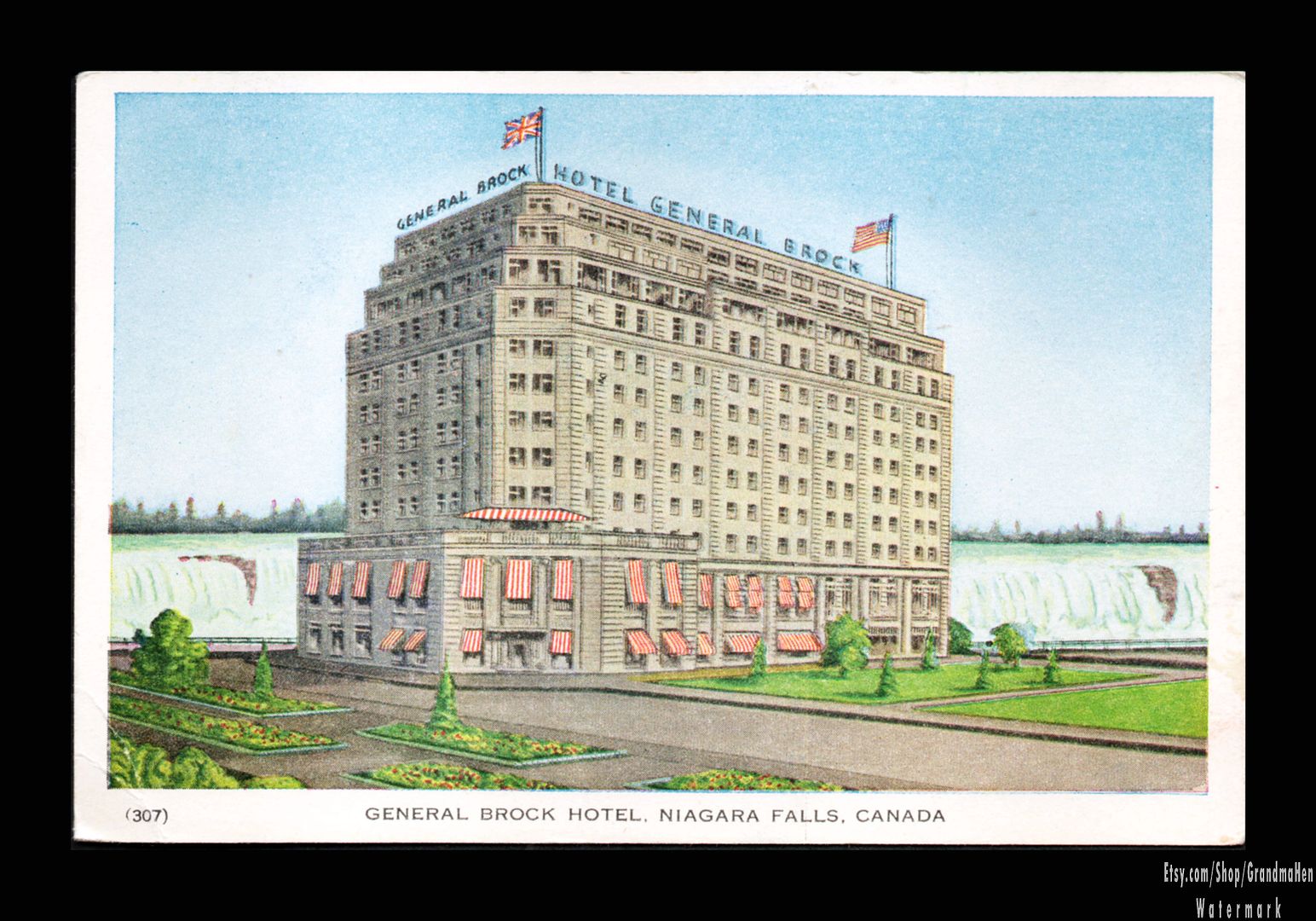
General Brock Hotel Niagara Falls Canada Vintage Color Halftone Postcard

General Brock Hotel ca. 1948
General Brock Hotel
Niagara Falls, Canada
No. 307
Printed in Canada
3-5/8 x 5-1/2 inches
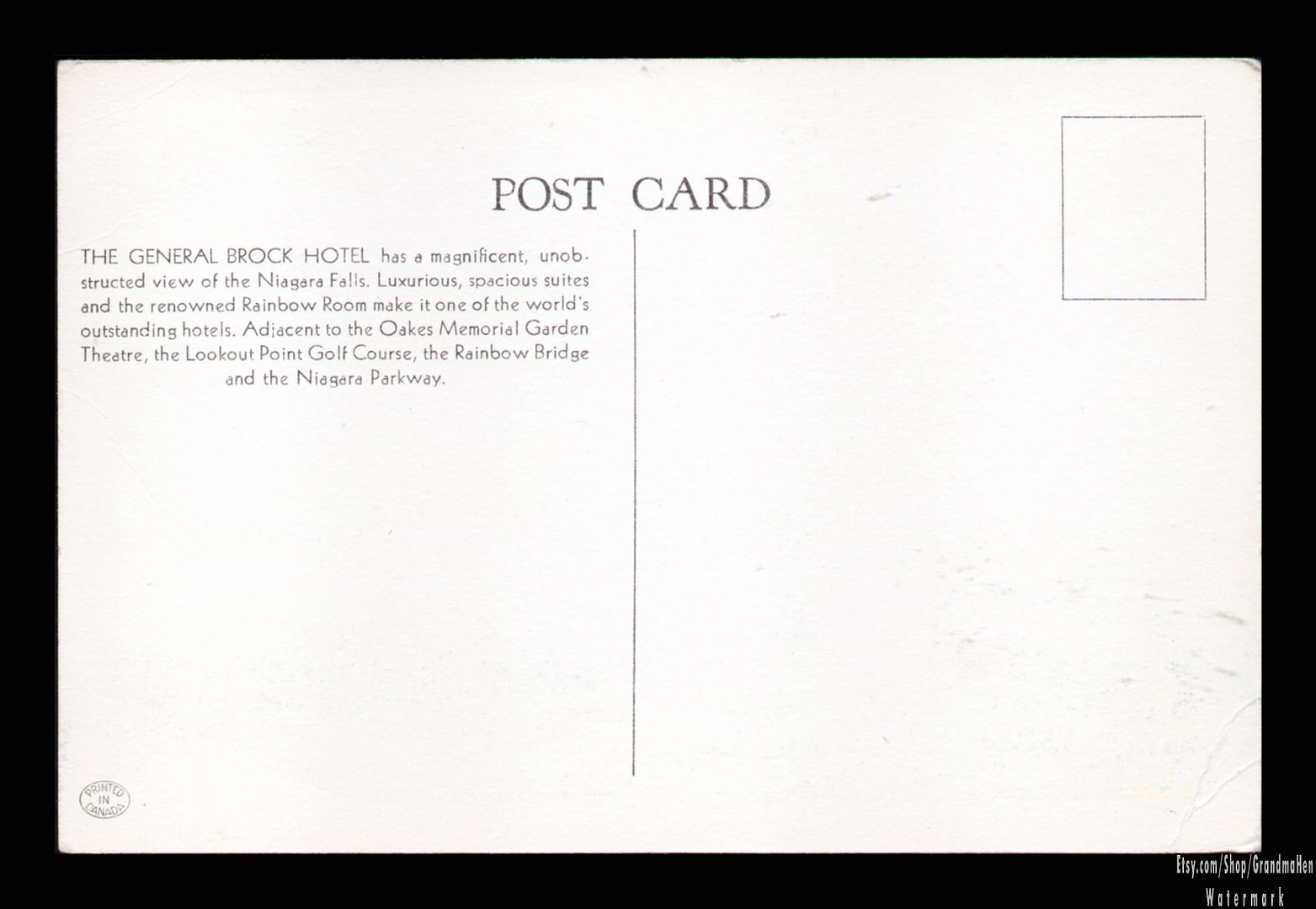
Divided Back, Blank Stamp Box

Blog Post by Mary Katherine May. Rick and Mary May operate QualityMusicandBooks.com and the GrandmaHen Treasure Shop on Etsy.

Here is an example of a vintage post card which is not in the best condition due to a major corner crease that can be creatively used as an educational tool.

Historical Niagara Falls, Canada
The General Brock Hotel has a magnificent, unobstructed view of the Niagara Falls. Luxurious, spacious suites and the renowned Rainbow Room that it one of the world’s outstanding hotels.  Adjacent to the Oakes Memorial Garden Theatre, the Lookout Point Golf Course, the Rainbow Bridge and the Niagara Parkway.

In January, 1929 construction began on the General Brock Hotel, the first high rise hotel on the Canadian side of Niagara Falls.  On the top floor of the eleven-story structure was the glass-enclosed Rainbow Room, a banquet hall offering a superb view of the Falls and Niagara Gorge.  

The hotel opened for business in July, 1929, after which two more floors were added to the building. Over the years many prominent celebrities stayed at the General Brock Hotel including Walt Disney, Shirley Temple, Queen Elizabeth, Marilyn Monroe, Bruce Willis and Jackie Chan. Today the hotel is known as the Crowne Plaza Niagara Falls Fallsview Hotel.

General Brock Hotel, Niagara Falls, Canada
History and Biography: Isaac Brock, War of 1812
Major General Sir Isaac Brock (1769-1812) was a British Army officer and colonial administrator from Guernsey. He became responsible for defending Upper Canada against the United States.  When the War of 1812 broke out, quick victories at Fort Mackinac and Detroit defeated American invasion efforts. 

At the Battle of Queenston Heights Brock was struck in the wrist of his sword arm by a musket ball but continued to press home the attack. His height and energetic gestures, together with his officer’s uniform and gaudy sash given to him eight weeks earlier by Teccumseh after the Seige of Detroit, made him a conspicuous target. An unknown American stepped forward from a thicket and fired at a range of barely fifty yards. The musketball struck Brock in the chest and he fell. His last words have been reported (though unlikely spoken) as “Push on, brave York Volunteers!”  The hole in his uniform suggests that the bullet entered his heart and he died immediately.

Canadians regard Brock as one of their greatest military heroes. Though not born or naturalized as a Canadian, he was voted number 28 on the television show The Greatest Canadian. 

HISTORY OF POSTCARDS AND PRINTING
The question when dating this postcard is to look at its photograph and count the floors. In 1948, two additions stories were added to the original eleven. A verification is easy to do by looking at contemporary internet photos. I found used two copies of this card for sale with postmark dates of 1949 and 1951.

The number 307 shows it to have been one card in a series. The series could have been about scenic sites in Canada or part of a souvenir set showing views of Niagara Falls. 

An interesting research project would be to look for 1948 information and photographs of Niagara Falls to put the building into the context of the time.

Looking at the scene with a magnifier tells me it is a halftone print made with little dots of color on a white background that when looked at from a normal viewing distance appears as solid color.

General Brock Hotel, Niagara Falls, Canada. No. 307. Printed in Canada

Sunday, January 1, 2017

Real Photo Post Card Man Framed with Leaf Shaped Border

Real Photo Post Card
Real Photo Post Card Man Framed with Leaf Shaped Border

Blog post by Mary Katherine May

     An interesting variation of the Real Photo Post Card is the photo portrait with uniquely shaped borders.  The one shown here is of a handsome, clean-cut man with classic features from the sometime during the first two decades of the twentieth century.

According to a MetroPostcard Guide (highly recommended site) the border shapes were created by using stencils:
LINK The most common exception to this were cards shot through a stencil to provide a decorative white border. These stencils were usually cut out of tin or heavy paper and would be sandwiched between the photo paper and negative during exposure to the sun. While these stencils could be purchased in stores and came in various designs, many forgoed the expense and made their own. Homemade stencils were rarely perfectly symmetrical and are a tell tale sign of non-commercially printed cards.
     The attractive shape, such as a leaf, apple or scroll, immediately draws the viewer's curiosity to look inside as though peering through a window.

For the collector of real photo post cards acquiring a group using different shapes might be an interesting subset group.

This particular post card has no message on its divided back, yet I feel drawn to wonder about what kind person this man was--tall or short? professional or dressed up for the photo? quiet? happy? a loner?

Details
Unused
Divided Back
Real Photo Post Card: People
AZO Stamp Box: 4 Triangles Pointing Up
Post Card as Two Words
Leaf-shaped Border


Rick and Mary May operate the webstore Quality Music and Books, and also the GrandmaHen Shop on Etsy.com. 

Thursday, December 29, 2016

PostCard Talk Real Photo Post Card Roundup Montana 1929

Roundup Montana High School (No. 45)


Vintage Real Photo Postcard

45-High School, Roundup Mont.
Blog Post by Mary Katherine May

MESSAGE
Dear Dad: We've been in Roundup about a day, and leave for coast tonight. Every one was just fine. Bessie has two children, a boy and a girl, who are very cute. Our trip here wasn't bad at all as we slept thru the plains of South Dakota and Montana. When we go to the bad lands things became more interesting. Everett.

ADDRESSEE
Mr. Edward Earsley
405 Simmons Ave.
Huron, So. Dak.

DESCRIPTION
AZO Stamp Box: 2 triangles point up, 2 triangles point down. Divided back. Used. 3.5 x 5.5 inches. Real photo Post Card (No. 45) showing a black and white photograph of the high school built in 1918 in Roundup, Montana. The much-needed high school was built due to a large increase in student enrollment.

POSTMARK
August 29, 1929
Roundup, Montana

CANCELLATION
7-Wavy Bar Killer


HISTORICAL CONTEXT
The U.S. Stock Market reached its peak in August of 1929 before collapsing in October issuing in the Great Depression.

On Thursday, August 29, 1929, the Graf Zeppelin completed its round-the-world trip back where it started in Lakehurst, New Jersey.

The Story: Everett and Edward Earsley
 A divided back post card written by son, Everett Loyd Earsley to his dad, Edward Earsley in Huron, South Dakota.  Although Everett doesn’t write his surname it is a good assumption to think that his last name is Earsley.

Although difficult to read the postmark because of the written message, a close look reveals it to have been sent from Roundup, Montana on August 29, 1929.

Everett is on a trip with others, maybe by train, making a stop in Roundup on the way to the coast.  Not much attention was spent looking at scenery except for the Badlands, and maybe for good reason as it is said that the plains of Midwest America is one long wave of amber grain.

We cannot know, but perhaps this was vacation taken as the last hurrah before entering the dental school at the University of Minnesota in September.  Graduating in 1932, Dr. Earsley set up a dental practice in Winona, Minnesota, with fellow graduate, Dr. Paul Pettit of Minneapolis, Minnesota.  He served as a dentist in the U.S. Army during World War 2.

Earsley was the only child of Edward and Sophia Sonnenberg Earsley, born in Winona.  As this Earsley family began and ended in Winona, the post card, addressed to Huron, South Dakota, was perhaps where they were living because of a job transfer since Edward was employed by the Chicago & North Western Railway.

Dr. Everett Earsley died in 1997 at the age of 90. 

Friday, November 21, 2014

Jesse James Centenary Numbered Mourning Cover 1982

Jesse James Centenary Mourning Cover
Numbered 232/500
Jesse James Centenary April 3 1982
Postal Cachet
Created by Richard T. Crowe
Numbered 232/500

This blogpost article by Mary Katherine May of QualityMusicandBooks.com

Because of my interest in mourning covers at some point in time I acquired the cachet shown here issued as a commemorative in a numbered quantity by Richard T. Crowe. The cover I have is number 232 of 500.

It seems a little odd to me, however, that since I am ready to sell it, I cannot find another on the internet for sale which poses a problem for me since I have nothing to upon which to base my price.  Generally speaking, this is not a necessarily unusual except that the field of postal cachets in not my field of expertise. I collect, but not in great numbers or great prices.

Jesse James Centenary Cachet Postmarked April 3, 1982 in Saint Joseph, Missouri
Artist: Richard T. Crowe
Stamped [Signed] by Richard T. Crowe
Limited Numbered Cachet: 232/500


Jesse James fascinates many Americans, as he evidently did Richard Crowe.  The cachet itself has the marks of being done well but not perfectly.  Though the Remington stamp appears square to the eye, the 2 cent stamp does not. Looking not too carefully at the black mourning border, it looks to possibly have been marked by hand because of the uneven color and spots outside the border.

Posted on April 3, 1982, in Saint Joseph, Missouri, the stamp mark is clear, large, and readable.  The quotes and remarks tell us the sentiment of Crowe toward James, calling him the American Robin Hood, and that he stole from the rich to give to the poor.

Most likely the creator of this Jesse James centenary mourning cover was Richard T. Crowe of Chicago, Illinois, who was known for leading ghost tours in his city.  Crowe also was a deltiologist or postcard collector who had a special interest in the Old West. It is reported that he names his cats Jesse and Frank after the James' brothers.

Link to Chicago Sun Times article about Richard T. Crowe on the even of his death.

Sunday, November 2, 2014

Lewis Lice and Fly Destroyer Company Old Mail Shows Interesting Trademark Logo

Trade Mark log for Lewis Lice and
Fly Destroyer Company
Entered in the U.S. Patent Office June 9, 1913
Postal Ephemera
Agricultural Ephemera
Maine and Massachusetts Business History

This blog post article by Mary Katherine May of QualityMusicandBooks.com.


If you are interested in ephemera and postal items in particular, you will have particular elements that will peek your interest while browsing antique stores, thrift shops and online sites that sell such items.  It was the image on this particular item, though not a postcard, that first caught my attention.


The Trade Mark logo with a framed photo inset bordered with a cow head, horse head and chicken actually makes me smile because for some unknown reason that without doubt made good sense at the time now in the 21st century I think has humor.


George W. Lewis and Son

Lewis Lice and Fly Destroyer
George W. Lewis and Son was a successful business operating in Westboro, Massachusetts, which on June 9, 1913 filed this Trade Mark with the U.S. Patent Office for the Lewis Lice and Fly Destroyer Company. LINK

The logo image makes sense, since we get an immediate visual picture of what animals will benefit from this particular product that kills lice and flies, and more. The portrait of George Lewis and his signature lends authenticity and recognition of a man who stands behind his product.

Postal History from 1913
We might question, however, how a product patented in 1913, the same as the postmark year on the envelope, can have experienced 12 years of wonderful success as stated, but perhaps Mr. Lewis was just a little slow in registering the product he had been selling for quite some time.

Opposite the above claim we read that the product is perfectly harmless, no dangerous effects if the animals lick it, which animals will do.  Was this claim true?  According to the Annual Report of the Maine Agricultural Experiment Station in a general statement for this and similar products,  LINK

"They are very much alike and depend upon a mixture of vegetable oils, hydrocarbons from petroleum, crude petroleum and coal tar derivatives for their repelling power."
A Lewis Company ad in the Marion Star, Marion, Ohio, June 21, 1913, promises a money back guarantee if not satisfied along with the following: 
"We guarantee that this Lice and Fly Destroyer will kill flies on cows and keep them off all day; cure barn itch and cure cattle lice.  Also body lice on poultry and mites in poultry house.  When used as directed.  If not return empty can and get money back.  You Dairymen—come in and let us tell you how a can or two of this Fly Killer will increase your herds flow of milk during the summer.  It’s sold quart, half gallons and gallons."
Ammi Whitney and Hosea Kendall formed their partnership in 1858, and had run successful agricultural business in Portland, Maine for over fifty years at the time this envelope was posted in 1913.  LINK 1.     LINK 2.

Ammi Whitney

Hosea Kendall
My research turned up very little on Mr. Kendall, but I found some interested information on Ammi Whitney of which I offer a portion here along with a link to the source.

Ammi Whitney (1833- ) was an infant of six weeks when his parents removed to Falmouth. He remained on the farm until twenty years of age, in the mean time acquiring a fair education in the common schools of the town. He then went to Boston and entered the employ of the old firm of Parker & White, dealers in seeds and other agricultural goods. He spent nearly six years in this employment, returning to Portland in 1858, and forming a partnership with Hosea Kendall in the same kind of business.


Essentially a self-made man, he has attained prosperity by the exercise of natural business talent, a conservative judgment, and a scrupulous probity in business as well as in all other relations. LINK.

Though I cannot say for certain, it is my thought that George Lewis would have paid to have his product advertised on Kendall and Whitney stationery--a good marketing tool for all and revenue for Mr. Kendall and Mr. Whitney.  

Postal Marks
Regarding the stamp, postmarks and postal killer, there is nothing unique or special about them. There are two postmarks, one at point of sending and on the envelope back side one at point of receiving.  The blue date stamp on the front most likely was stamped upon J.L. Chick receiving his mail, which is a common office method of documentation.

Source: Portsmouth Herald, Portsmouth NH, 15 January 1951

Joshua L. Chick
Chick Farm
Wells is about 33 miles south of Portland, and the location of Chick Farm run by the Chick Family. Joshua Chick, or J.L. Chick as addressed, was the proprietor of a agricultural or general store, depending upon what information you look at.  It seems that Joshua L. Chick never married and was at some point a municipal officer of his city in the capacity of Justice.  He lived 78 years, which was a good, long life in the first half of the 20th century. LINK.

Missionary Rev August Lindstedt 1923 Christmas Greetings Harbin Manchuria China

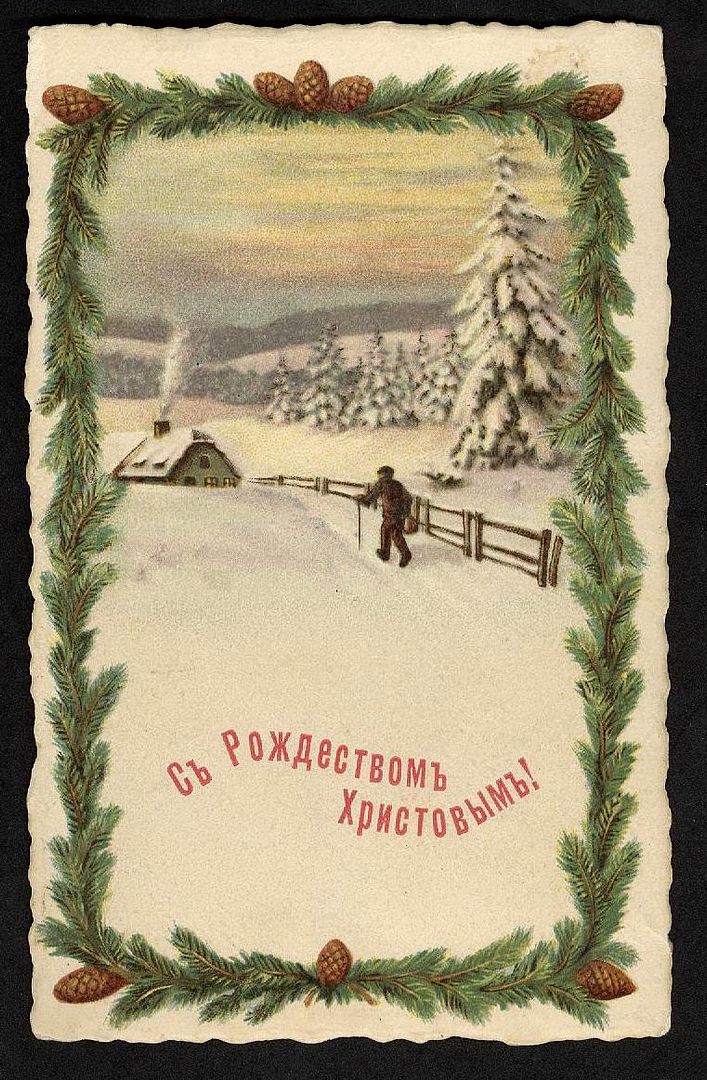
Christmas Greeting in Russian Language
sent to a Swedish Baptist Missionary in
Manchuria, China.
Vintage Postcard: Christmas 1923
Manufacture: BNK
      (who knows about this company?)

This blog post article offered by Mary Katherine May of QualityMusicandBooks.com.


Sometimes a postcard comes your way that sparks great intrigue, and this is one such postcard. Let's take a look with what we have to work with.


1. A man walking at a good pace over snow-covered ground toward a cheery looking cottage with smoking from the wafting into the wind.


2. Well-shaped fir trees blanketed in white.


3. A distant horizon under a soft, glowing sky that adds expanse to the small illustration.


4. The first hint of the holiday is found in the garland scattered with pine cones bordering the scalloped, rough edges of the card. They look blue-green in color to me--spruce, perhaps?


5. A Christmas greeting in the Russian language printed in red, and now the two traditional colors are present.


Truly, an International Postcard

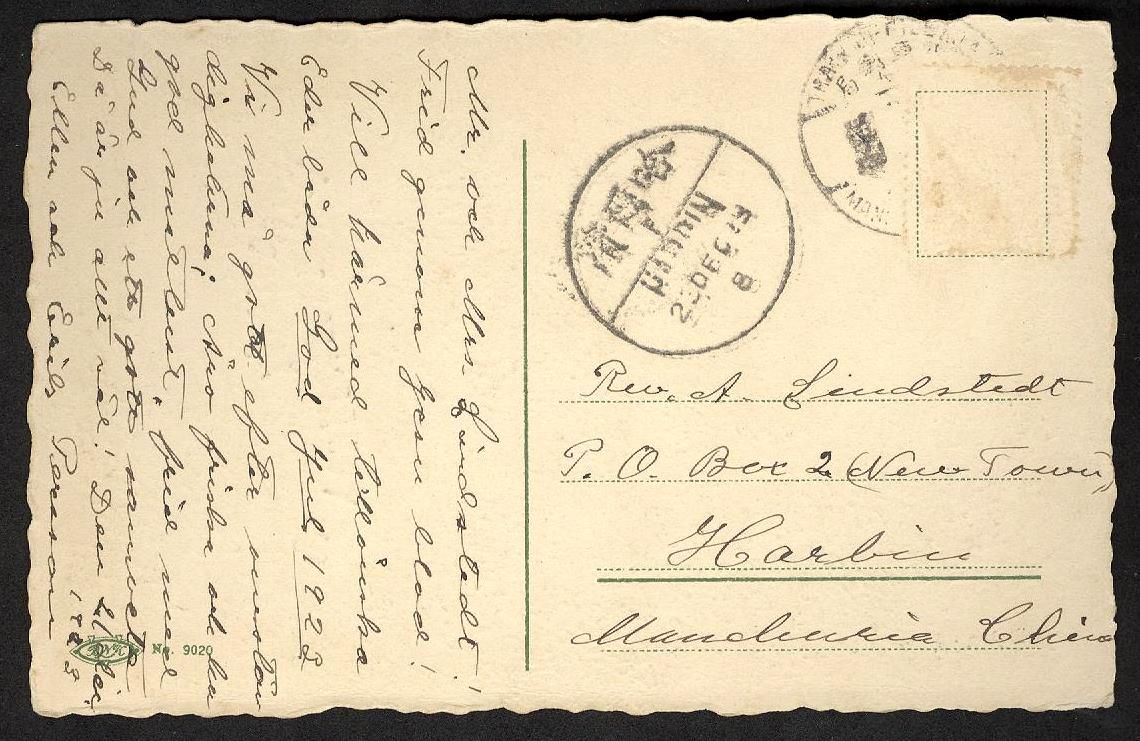
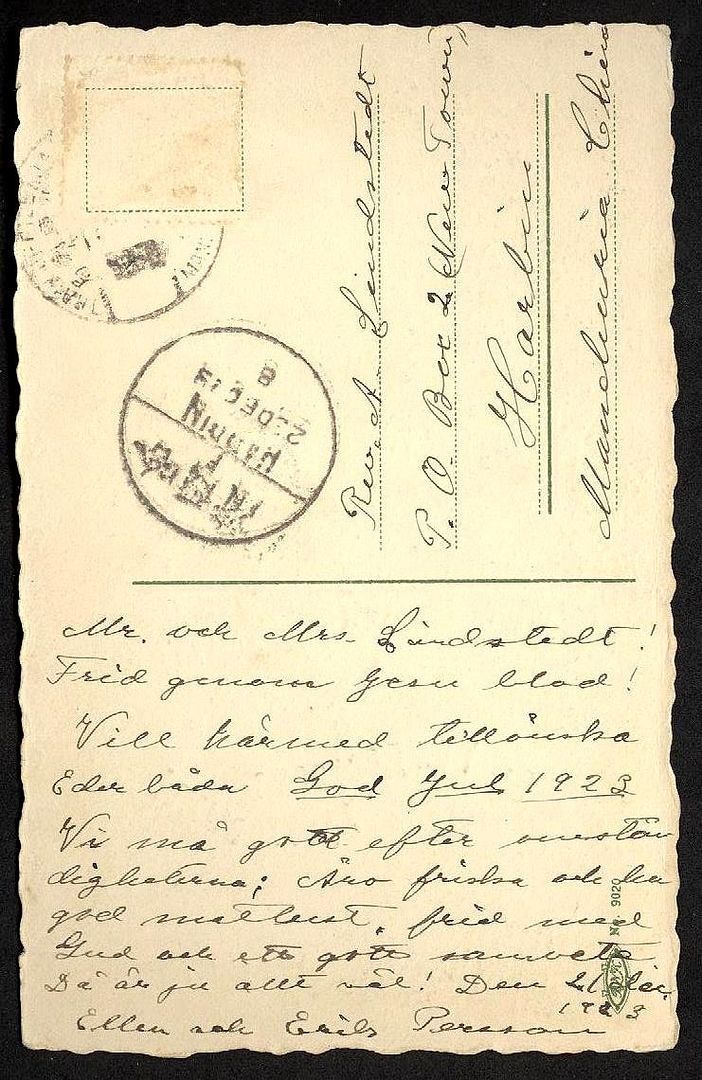
Turning the card over--and this is SO exciting--is the message written in Swedish. Trying a translation tool won't help because I can't make out what it says except for God Jul 1923, and the signers, Ellen and Erik Persson.

But wait! There is more! The postcard is addressed to Rev. A. Lindstedt, P.O. Box 2 (New Town), Harbin, Manchuria, China.


Russia, Sweden, China: It All Comes Together

There is not a great wealth of information on the internet about Rev. Lindstedt, yet what is available offers an amount sufficient to understand what a brave undertaking the Reverend and his family did through the strength and grace of God.


Message to Rev. August Lindstedt from Ellen and Erik Persson, mailed to Manchuria, China
Unfortunately for us, we can see that the postage stamp has been removed.
More Information
August Lindstedt and his family served as missionaries of the Swedish Baptist General Conference in Vladivostok from 1916 to 1917, and among Russians in north China and Manchuria from 1917 to 1946. In the early 1920s Conference assumed control of the Chicago-based Swedish Baptist Foreign Mission Society brought to culmination agitation - and practical efforts that had extended over more than three decades. Earlier grassroots support through the Nya WeckoPosten thus became recognized support of the Lindstedt family in Siberia and China.

God Jul 1923 from Ellen and Erik Persson
to Mr. and Mrs. Lindstedt.
Rev. August's son, Marvin offers a short, well-written article on the work of the Swedish Baptists in China in an edition of Trail Markers, a Bethel University publication.  I quote a brief passage here:

E. W. Olson was an East Coast Conference pastor who had once been to Siberia and wanted to return as a missionary to the Russians. Olson had friends in Sweden, and traveled there to try to stir up interest and financial support for the work he envisioned. In Sweden, Olson met and recruited August Lindstedt, a young Christian who believed that God wanted him to preach the good news of salvation to Russians.

Update Reports in the U.S.A.
When missionaries to foreign countries are here in the U.S. on sabbatical or other reasons, they frequently give talks at church functions to report on their progress and help raise money for their work. Contributing to the support of missionary work is a way for all Christians to be a part of Jesus Christ's Great Commandment in Matthew 28:19-20. 

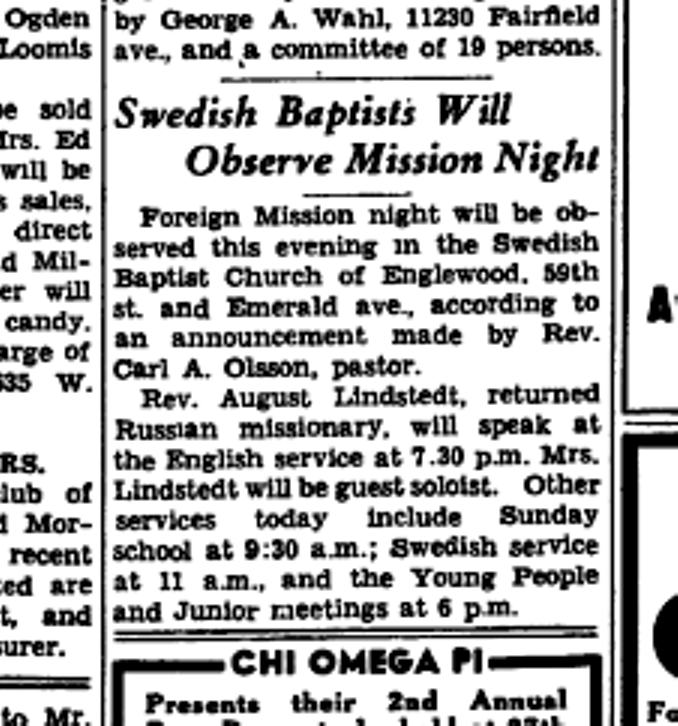
Here is a newspaper clipping announcing an upcoming talk by Rev. Lindstedt from the Southtown Economist, Southtown, Chicago, Illinois, October 23, 1938.

Announcement of Rev. August Lindstedt  upcoming talk.
Mrs. Lindstedt was guest soloist.


Missionary Life
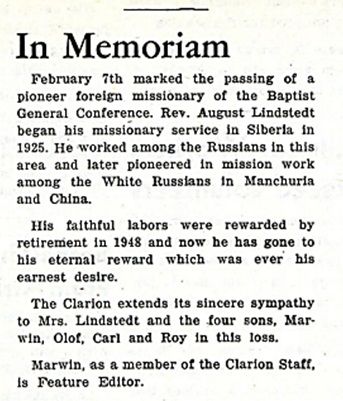
The Clarion, Bethel College and Seminary's newspaper, in the February 1950 issue gave report of Rev. August Lindstedt's entrance into the the blessed rest of the Lord. Missionaries, in this case a husband and wife and their family, often live a hard life out of love for the work they do, and health is often compromised in the course of their efforts. This ends my brief account of how much can be learned from one small postcard with a Russian Greeting, a message written in Swedish, and sent to the Russian enclave in Harbin, Manchuria, in December of 1923.