Wednesday, July 24, 2013

WWII US Air Corps Series Postcard Talk

Curteich U.S. Air Corp Series 3 and 9
by Mary Katherine May of QualityMusicandBooks.com

As an educational tool old, vintage postcards can be a fun way to learn history.  Using the two postcards associated with this blogpost, my goal is to demonstrate what I learned using the internet in one afternoon about the World War II time period.

Keep 'Em Flying Slogan
U.S. Air Corps Series published by Curteich.
It was common for postcard publishers to introduce a set or series around a particular theme. The U.S. Air Corps Series of postcards. Keep 'Em Flying slogan was adopted by two bases in Illinois.
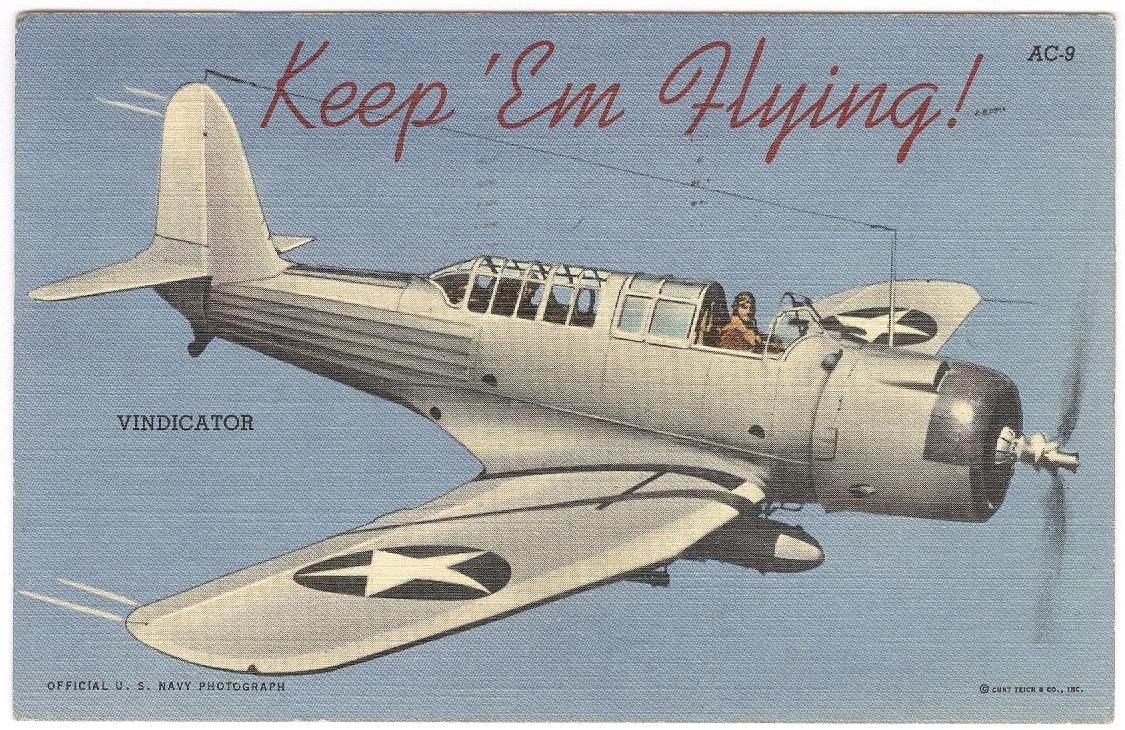

Curteich US Air Corps Series 9
Keep 'Em Flying: Vindicator
The Vindicator was the first carrier-based dive bomber in WWII.  Although considered obsolete before the beginning of the war it did see action, suffering heavy losses at Midway.

Keep 'Em Flying: Bomber (link: North American B-25 Mitchell)
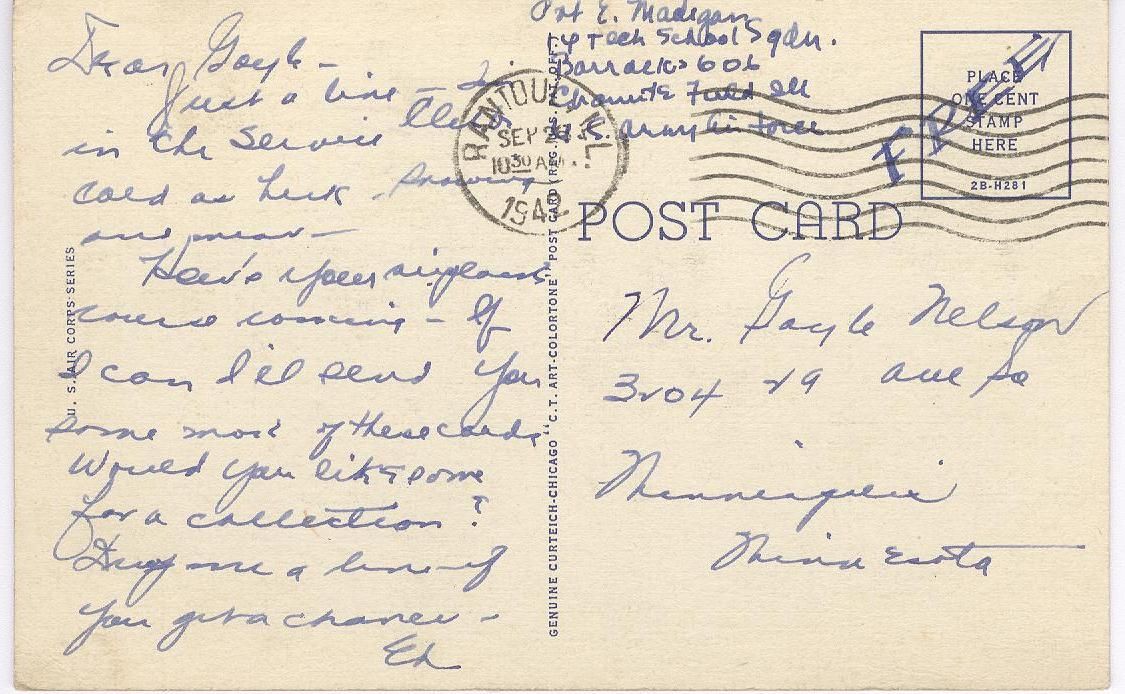
Teich used a code system for dating the year of manufacture. For example, the code 2B, means the postcard was printed in 1942.  Ed Madigan was stationed at Chanute Field near Rantoul, Illinois.  He was in the U.S. Army Air Force, which previously had been called the U.S. Army Air Corps, and which later became the U.S. Air Force. 
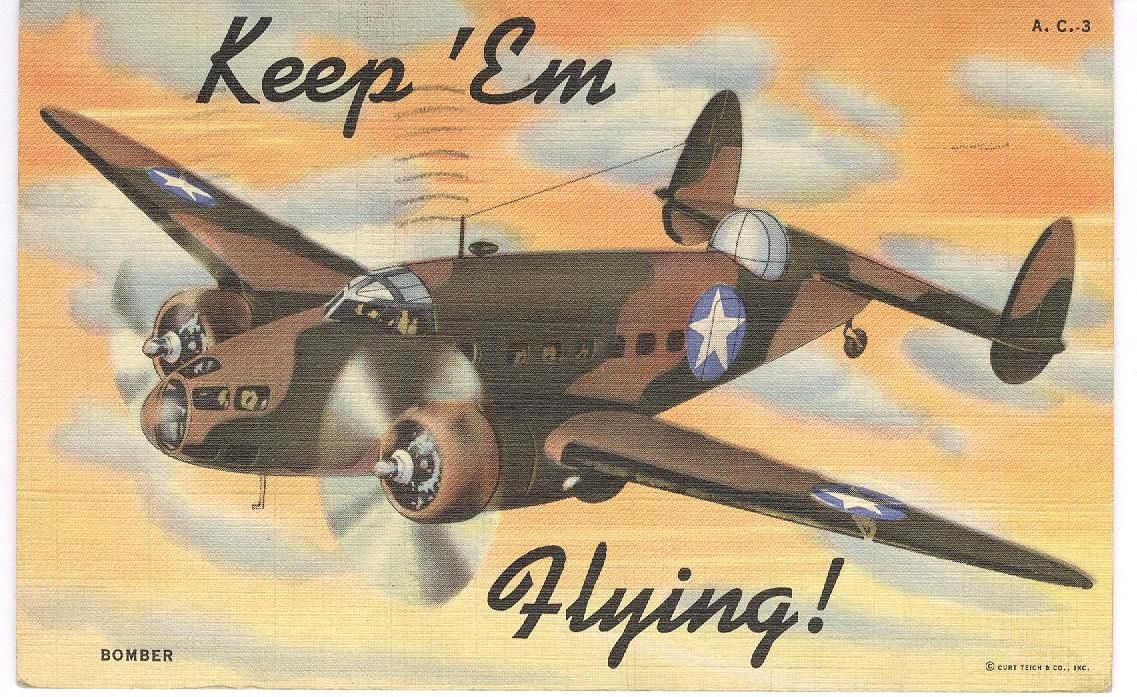

Curteich US Air Corps Series 3
Chanute Field, where Madigan was stationed in the Technical School Squadron, was used for technical training. Technical staff was very important to the war effort, as the ratio of ground staff to flying staff was about 7 to 1.  Octave Chanute, for whom this base was named, was a railway engineer and aviation pioneer who was an advisor to the Wright brothers.

Ed wrote this postcard to Mr. Gayle Nelson who may want more of the same for a collection.  I am uncertain about the relationship between Ed and Gayle, whether he was a friend or relative.  The Vindicator postcard is also written to Gayle and signed by Mom--but she refers to Edward, not Ed.  This is something a mother would do.  And if not Ed's mother, why would she be in Rantoul, Illinois? Interesting to speculate upon.
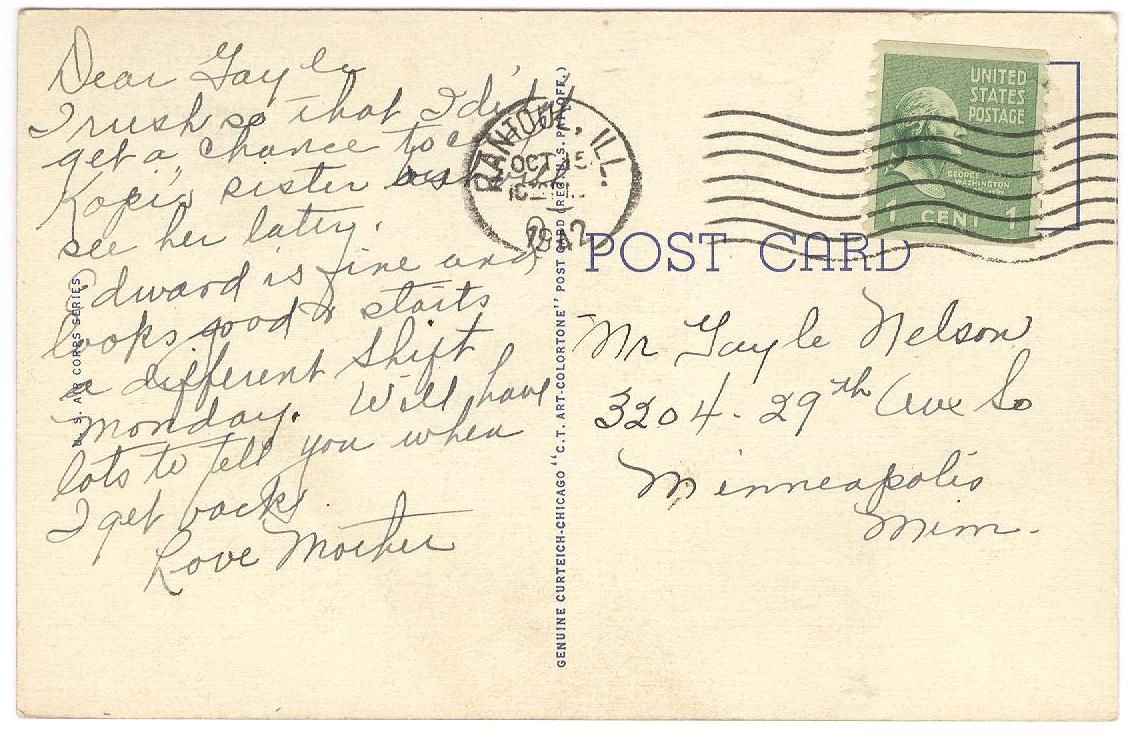
US Army Air Corps Series 9
US Air Corps Series 3
Postcards, Publishers, Paper and Printing
The Vindicator and Bomber postcards were published during the time period called the Linen Era, which began in 1935 and went until about 1950.  During this time the picture side of postcards were generally printed on paper that had a linen fabric look.  Although this linen look is often attributed to a high rag (cotton) content in the paper, I could not document that this is so. Thinking logically, paper since the mid-nineteenth century had been manufactured from wood pulp which was more cost effective, and adding rag pulp to wood pulp isn't a necessary factor in creating a linen fabric look and feel. 

Curt Teich, the publisher of the two postcards shown here, was an innovator in the manufacture of postcards.  Before he could introduce his linen-look postcard Teich had to come up with a way for heatset inks to dry faster, and his creativity made a significant difference in the printing industry.  He named the offset printing process he used Art Colortone, which at least at first involved stones he collected from Lake Michigan.


Curt Otto Teich came to the United States from Germany, where his family was in the printing business and he trained as a printer.  As Germany dominated the postcard publishing market until the onset of World War I, Teich had the advantage of training in the location where this type of correspondence stationery was successful. But what made the difference for him was that he joined the technical with an exceptionally creative mind.  He traveled across country taking scenic photographs, taking orders along the way. He put his mind to the task of coming up with something unique and different.  Today there are collections and collectors who focus upon linen era postcards and also those published specifically by Curt Teich.

Monday, October 15, 2012

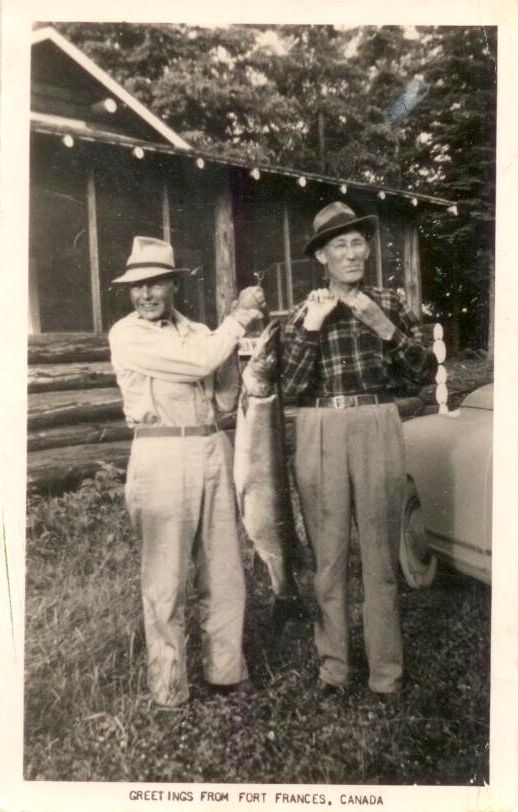
2 Men and a Big Fish Vintage Postcard Greetings from Fort Francis Canada


Greetings from Fort Frances, Canada
Vintage Glossy Post Card
The Big Fish That Didn't Get Away


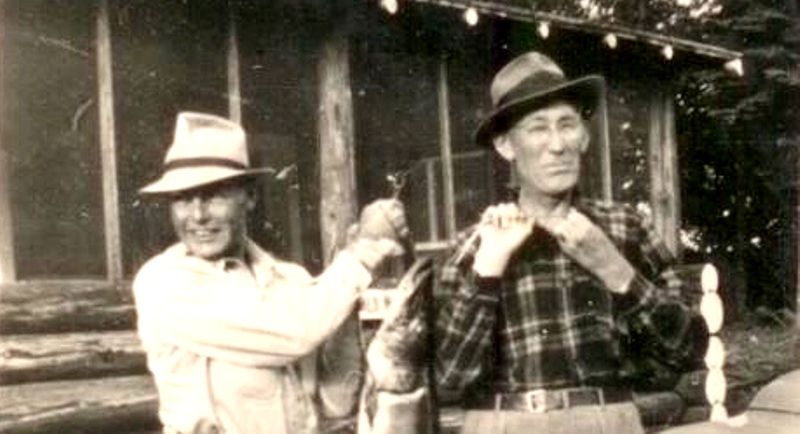
Tall tale or fish story?  In this case, it is the big fish that is so big two men are holding it up for the photo--and this one didn't get away!


Most of the postcards I am interested in are used and have a message written on them, but this one captivated me when I saw it.


The young man, maybe a grandson with a big grin looks a bit like Jimmy from the old Superman TV series.  The older gent in his plaid flannel shirt has a face with classic features and an expression that brings on a smile.  I am certain that both are holding the fish up, but cannot quite see how the man on the right is participating.


This is a glossy photo postcard. A knowledgeable person who knows their cars might be able to identify  the era even with just the little bit of car that can be seen, but I am not one of those people.

The caption tells us tht the photo was snapped at Fort Frances, Canada, located along the Minnesota/Canadian border.  That is Frances with an E, not an I, names after Frances, the wife of Sir George Simpson  (Frances with an E for her, Francis with an I for him).

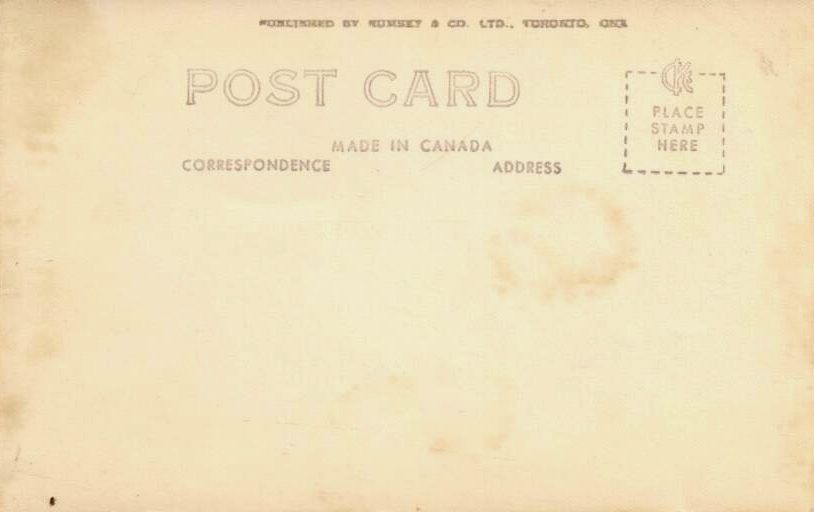
This undivided back post card, at least the blank, was published in Toronto, Canada, by Rumsey and Co., Ltd.


This vintage collectible postcard has now sold on ETSY.

Saturday, September 22, 2012

Pillsbury A Mill 1909 Signed Gibson and THE ITCH Postcard Talk

PostCard Talk
Mary Katherine May
QualityMusicandBooks.com

Minnesota entered the Union in May of 1858, on the heels of the Panic of 1857 and when on the cusp a large growth in population.  Water was everything.  Settlers first came by water, or across water to  stake their claim in what would be called the Land of 10,000 Lakes. 

Water was what drove the two major industries in the Minnesota Territory and New State, logging and milling.  Logging for lumber to build, but also to drive the wheels of the milling industry, until the trees were all gone.

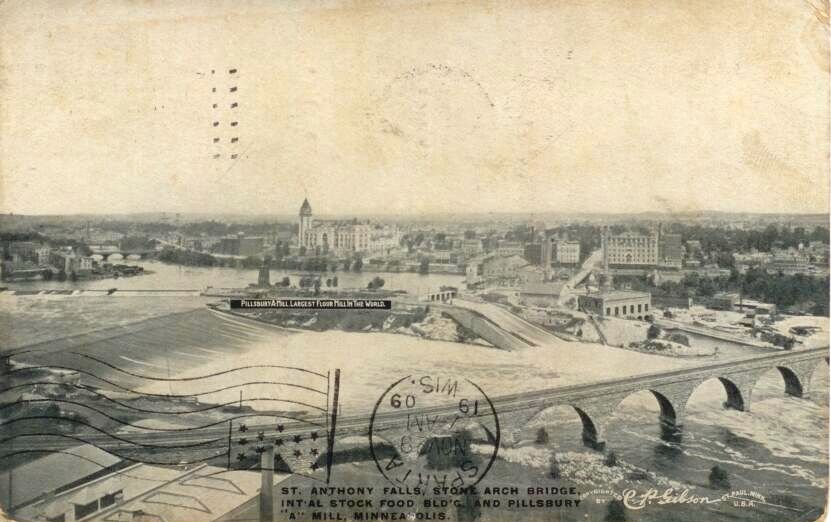
Mr. Pillsbury did his homework.  He traveled and studied how the best flour mills around were built and operated, and then declared he would build the largest mill in the world.  The Pillsbury A Mill went into operation in 1881.  Our postcard here is dated 1909 by the postal cancel.  Unfortunately for us, the photograph takes in such a large area that the buildings, river, and falls are too small to get a good look at the details. 

The photo was taken by Charles P. Gibson of St. Paul, Minnesota.  We can tell because it is 'signed' on the front, lower right.  Mill A is labeled in a text box, and other descriptives are printed at the lower edge center as follows.

Int'al Stock Food Bld'g, and Pillsbury
"A" Mill, Minneapolis.


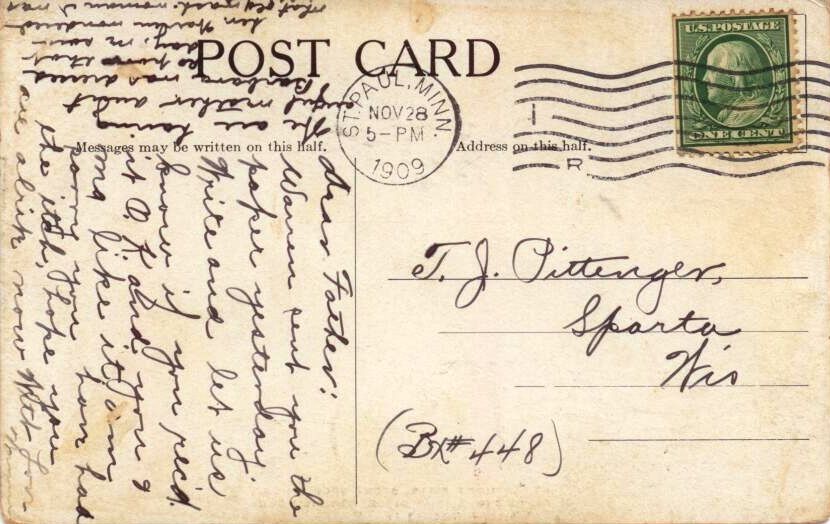
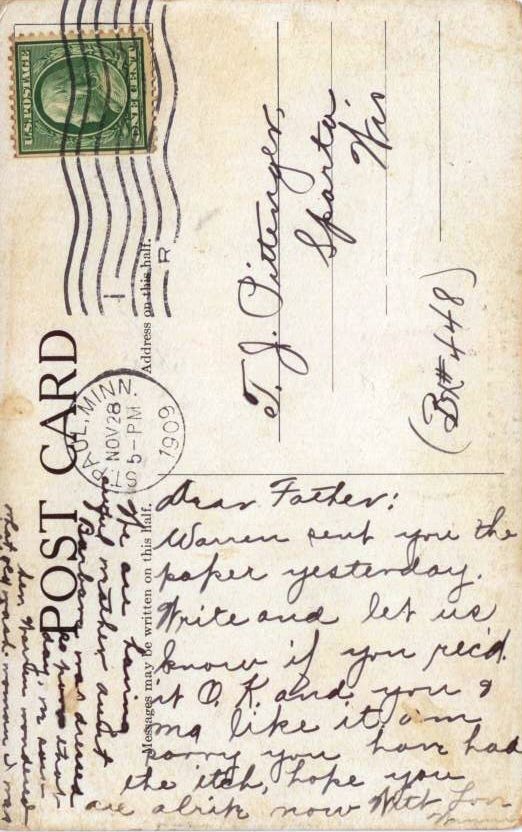
Postally what is interesting is the double cancel. On the front at the lower edge and upside down is the postmark at the receiving end: Sparta, Wis., Nov. 29, 1909, 7 AM, along with a flag killer.  On the (divided) back is the mailed cancel: St. Paul, Minn., Nov. 28, 1909, 5 PM., with a seven wavy line killer.

We know that the addressee, T.J. Pittenger (or Pittinger) in Sparta, Wisconsin was the Father of the sender, who may have been named Winnie, or Winnifred.  The signature is small, in the corner, and faded.

Poor Father, he has an itch.  An ongoing itch can be a terrible thing--a person can't sleep, can't sit, can't even think sometimes.  We don't know what was causing it, but it must have been disrupting his life.

Dear Father:
Warren sent you the paper yesterday.  Write and let us know if you rec'd it O.K. and you & ma like it, am sorry you have had the itch, hope you are alrite (alright) now.  With Love, Winn

We are having awful weather Aunt Barbara was dressed so poor that day, (cannot read) her. Warren wondered what old wash woman I was talking to.

Did you catch what is missing?  that day ... When was that day?  Was was going on that day? Why didn't Aunt Barbara come out of the rain?  Why was she dressed in the wrong clothing for the weather conditions?  Did Winn and Warren help their aunt out, or after a conversation did she leave for home still wet? 

Questions! Questions!  We will never know--unless, that is, someone knows and tells us so the story can be posted here!

Monday, September 10, 2012

Are You Glad Cryptic Message Postcard Talk

Postcard Talk by Mary Katherine May

Undivided Back Postcard
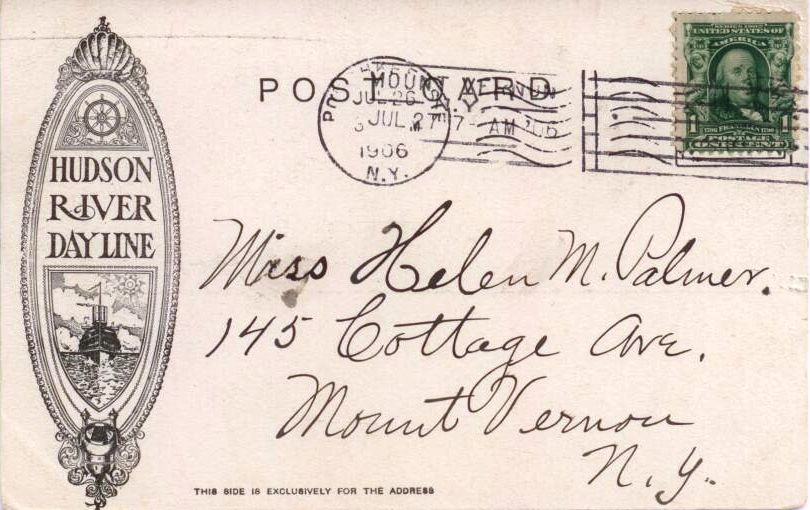
Double Stamped
Poughkeepsie N.Y. July 26th, 1906, 3__ A.M.
Mount Vernon N.Y. July 27th, 1906, 7 A.M.


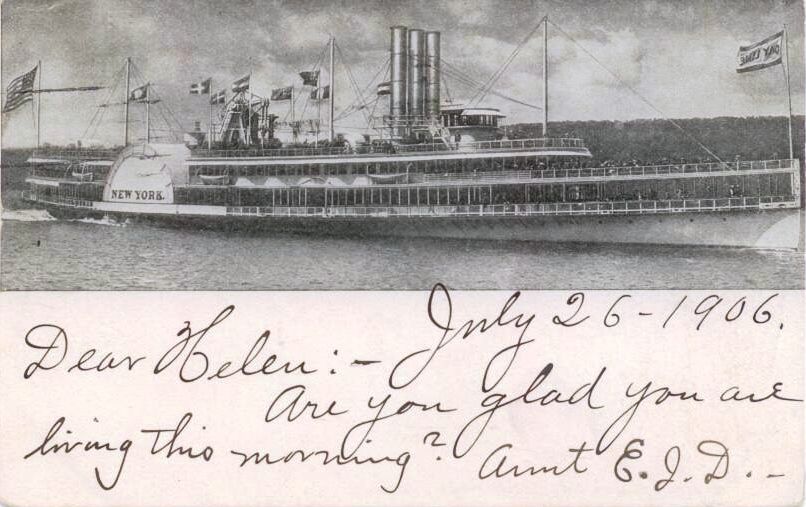
In spite of the minor edge wear and tear, this is a great postcard. The front shows a Hudson River Day Line ship, the address side has  a great Hudson River Day Line logo.  Double stamped posted marks, two flag killers--one looks to be in reverse of the other!

Addressed to a Miss Helen M. Palmer, 145 Cottage Ave., Mount Verson N.Y. 

July 26-1906
Dear Helen:--
Are you glad you are living this morning?
Aunt E.J.D.


The message, however, is completely cryptic, almost begging for someone to write a story.  What does it mean?  What happened to Helen previous day that caused Auntie to send a postcard note to her niece at 3 A.M.???  Was she in an accident?  Was she ill?  Did she meet the man she would marry?  Did our Helen try to harm herself?   Does the ship have significance or was it only a postcard Auntie had available? 

How did this 100+ year old postcard end up in Minnesota?  I did buy this postcard at a stamp show this summer, and I believe that there was one dealer there from New York.  Hmmm.........

Interesting. Very, very interesting.

Thursday, August 16, 2012

DPO Pequot Minnesota PostCard Talk Mary Katherine May

Sam's Resort on Lake Edna
Nisswa, Minnesota

PostCard Talk DPO Pequot, Minn.

There is a special place for me in Northern Minnesota which holds some of the best memories I have from the past.  This summer my husband and I were able to relive one of the memories when we stayed at Fritz's Resort in Nisswa, Minnesota, the property purchased from my Grandfather, Sam (Samuel, Simon) Wakaruk.  I think the best memories of the few times at Sam's Resort that I can recall due to my young age are when my brother and I would go down to the resort's dock on Lake Edna and feed dried bread crumbs that came out of a bag in the boathouse to the little sunnies and crappies that Grandpa Sam had trained the fish to expect. 

The resort, run now by Fritz's son and his family, is far different than when Sam maintained his 'fishing resort,' being mostly for campers, and I didn't mind that.  We did, however, stay in one of the original cabins, which mostly I also slept in as a young child.  The hospitality of the resort owners, Richard and Jane Geike, was helpful, kind, and friendly, and I think that even without having emotional ties to the place I would not hesitate to book another reservation.


Boathouse in 1951 at Sam's Resort
Sam Wakaruk walking along the shoreline of Lake Edna.


Same boathouse in 2012 at Fritz's Resort on Lake Edna
Nisswa, Minnesota

Uncle Tony and Uncle Ellis begin putting in the dock
at Sam's Resort on Lake Edna, Nisswa, Minnesota.

Just five miles north on Highway 371 is the town of Pequot Lakes, and the cabin on Sibley Lake where we spent a lot more time over many years, after my widowed mother married again.  There are so many good experiences that I can recall.  And though the old musty cabin is gone, along with its 'honeymoon' suite that had a window looking into the kitchen, a curtain for a door, and an ancient iron bed with mattress that leaned always to the middle, among the other family inside jokes, the memories that helped shape who we are today will live on.

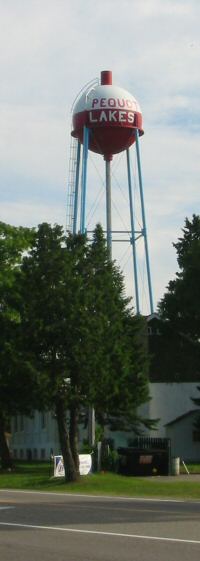
Pequot Lakes is known for its water tower that looks like a bobber.  They still make up a huge kettle of baked beans, cooked buried in the ground for Bean Hole Day, and at least used to put on a great small town Fourth of July with parade, races, tall tales contest, and more.  Today the movie theater, where we would go to watch movies for uner 50 cents after walking the mile into town now houses the Pequot Lakes Historical Society.

Pequot Lakes in its early years was associated with a few other names according to Crow Wing County history: Frogtown, Sibley, and also the single word, Pequot.  The town may have usually been called Pequot Lakes, but in regard to postal history the town was simply, Pequot, until some time in 1940, which is when the 'Pequot' postmark ceased to exist, and was replaced by Pequot Lakes.  The day after the last cancel, Pequot became what is known as a DPO, or Dead Post Office. 

DPOs, as they are called, are an option for a topical postal collection.  You will find DPOs on envelopes and postcards.  I happen to prefer postcards with a clear postmark and message, with the photo being of equal or lesser importance.  For me, envelopes with letters inside, particularly what are called mourning covers, run a close second in interest, and overall I lean toward postals originating in a select group of Midwestern States.

Over the years I have accumulated a few DPOs, and just the other day I noticed in my collection a few Pequot, Minnesota, postmarks, which were in existence form 1896 to 1940.

First Island, Sibley Lake, Pequot, Minn. ca. 1910-1919

Here is First Island on Sibley Lake in what was then known only as Pequot.  And actually at that time the property around the lake where our cabin was located was outside of the town proper.  My recollection from rowing back and forth on the 3 mile long, narrow lake, is that there was one island only, and this island was in the approximate middle of the 3 miles outside of the bay where our cabin, then owned by my stepfather's father, was located.  This island, if it is the one island and by what I see it very well could be, was also known as Goat Island, for the fact that someone would remove their goat or goats to the island for the summer to feed on the vegetation--and without the worry of keeping the goat from wandering away.

Dear Monson--card received glad to hear from you again. 
Am at Pequot in a car started for Bemidji a week ago Saturday
but was called back when I reached Hackensack. 
Think I'll be up this week Thursday.  Love from C. Bergren.

The top speed of the average car in 1915 was around 40  to 45 miles per hour.  If our postcard writer, C. Bergren, was able to go the 80+ miles from Pequot to Bemidji on the two lane roads cleared through the pine forests in Northern Minnesota, that would a little over two hours.  We have no clear idea as to why Bergren returned south to Pequot from Hackensack, and that is a mystery for speculation--not enough gasoline to fuel the car the whole way and not a good place to buy more?  Was someone sick, or was there car trouble?  If there was car trouble, our writer might have gotten the car serviced in Pine River if the dealership there is that long standing, and then stayed in Pequot with a friend or family, not needing to pay for a hotel.  Was the writer a man, since it is more likely for a man to address someone by their last name.  If it was a man, it is not typical to sign off with 'Love' unless Miss Sophia was his sweetheart.

Addressed to Miss Sophia Monson, Bemidji, Minn.,  (Box 432)

It is interesting to note that Miss Sophia Monson has a post office box, since most towns in Northern Minnesota are smaller than what many people call a small town.  The 1910 census shows Bemidji as having a population of approximately 5,000 people, then as now the largest town in the northern portion of the state.

Though the date is not completely present, the year may be 1912 because of the stamped line at the lower edge of the number one.  The month begins with an A, and I am speculating that the date is April 22, not August 22.

Lastly, the photograph over time has maintained good color, yet the lake is either still covered with a coat of ice, which is possible, or the water has been enhanced in some way. A close up of this type was either taken from a boat or with a zoom lens--were there zoom lenses in 1912? 

This article written by Mary Katherine May of QualityMusicandBooks.com.


Wednesday, August 15, 2012

1937 Bjork Letter PostCard Talk

PostCard Talk
Presented by Mary Katherine May
of QualityMusicandBooks.com

The second letter I present here before returning to postcards originated in Sweden.  I found it in an old Bible that came to me along with a few other books.  In another instance, in a group of books given to me by a friend, I found a letter from her deceased husband--which, of course, I returned to her.  For this reason, I recommend when asked to either purchase or accept books my recommendation that people leaf through them before showing them to me.

This letter was written in 1937, with all but a few lines the Swedish language.  We might assume reasonably that the recipient was located in the United States of America since here is where the Bible is located, in the state of Minnesota.  Unfortunately, because of my lack of Swedish language knowledge, my translation performed through Google Translate is at the worst extremely rough and at best somewhat close to what is literally present.

There is a sadness here for the separation that appears to have been complete for quite some time.  The author may have been in mourning or been in a depression, but still the writing implies a loneliness and sorrow over the fact that family communication is broken.  The recipient is not a distant relative, but an uncle.  There are separations among family members which occur that are not of our own choosing, and learning how to deal with them can be stressful and long time process.

The last line of the letter, written in broken English, really sums up the tone of the letter. I never will forget your girl and all of your other children.

Sollerön March 15 1937

Dear Uncle and Relatives….!

It is now a long time since we heard anything from me, maybe even a long time since you heard anything from that place where you have grown up and lived until your young sentencing days. I probably would have written for, but it's so hard not to believe that you are forgotten by us here on the island though it nests so watch out, after which I have not written to you in such a long time. Here it is now, as in other basins, new genera come to, and the old shall, mulling, down behind were old church, where we all a bunch of locals will end up. So I receive hereby tell of for you, that your sister, my mother,  now in these days have stopped his lifetime, So I may conclude with these simple rows announce you the sad nyket [news?], even is my father very sick, so we believe that even can die when sooner, the better. They have lived the sum man over 71 years, mother would turn 92 years on March 17,  mother ended their March 11, 1937.  Peace to her memory.

My father in law, parents, and so live still further, my father in law of Daniel Marten Jönsson has filled its 90 years, even my mother in law is on the 85th. But they, however, is healthy and well.

As you can see, you are now the only remaining of your Syrkon, for now, as I hope, these lines meet you in good health and cheerful mood, I do not know someone, address mi to Mrs. Annie Viberg, have not heard anything from them for years, so on you will be hard address, if you wanted to be nice and tell them that their aunt is now dead.

I will send your oll may bast gretings hops you soon wrieth to me.
I will send you all my best greetings.  Hope you will soon write to me.

I neaver forget your girl and your all oader cildrings.
I never [will] forget your girl and all [of] your other children.

Write once [soon?]
P. Bjork
Sollerön [Sweden]


Monday, August 13, 2012

Loved Lizzie Letter Dated December 28th 1856

Loved Lizzie

December 28th, 1856

on PostCard Talk


Presented by Mary Katherine May of QualityMusicandBooks.com

My thoughts about the letter.
On this posting I leave postcards for a moment to present a letter from 1856 so sweetly written to Loved Lizzie.  I know that this letter didn't come to me for free, though I cannot remember what it cost, and also the ink was faded at time of purchase though a little less so.  I recall that for some reason the letter then (whenever then, was), as it does now, struck me as particularly and softly senitmental.  Lizze is away, though we don't know where, or for what reason, or for how long.

I think, how wonderful the day would become if I received a letter in the post with such an endearing salutation.  If I was tired or sad or unhappy, to begin my morning activities by reading in my letter the bright, cheery greeting from someone I was close to in relationship and loved dearly,would surely make even a dark, cloudy sky seem joyous.

The letter from Lizzie's aunt is conversational and chatty.  A new baby named Louis Emerson just arrived, renovation of a church sanctuary, a good sermon heard, a marriage joke about how much Lizzie is adored.  A weekend guest named Emmah has gone home.   Francis is terribly ill but by the time of the post script a little better, and there is an upcoming party to celebrate the new year tonight at Wm. Whit's.  We can only speculate as to who the three men were that Lizzie lived with, since for certain in 1856 it wasn't just four random boarders living together with only one woman in the group.

It is truly a shame that ink is so faded, and that without input from a person who has intimate knowledge about the family of which Lizzie was a member it will be virtually impossible to specifically identify the who, what, when, where and how details of her life.  And perhaps that is just as well, since the imagination can make those who might have been absolutely ordinary, and not saying that Lizzie was ordinary in any way, light up like a bright, shiny star.

The names and clues:
Lizzie -- letter recipient
Rev. J.P. Lloyd -- there was a pastor by this name at the time of this letter's writing in Ohio.
Louis Emerson -- newborn boy
Emmah -- weekend guest
Frances -- sick with lung fever
Wm. Whit's --home where New Year party was to be held.
W.E.R. letter writer, Lizzie's aunt
Sylvester -- a person who lives with W.E.R.?

The letter came from Denmark --the country?  a city or town in the U.S.A

Denmark Dec 28th /’56
Loved Lizzie
I now attempt to reply to your very kind letter which was received on Friday last.  Happily I have found the pen and paper on which to fasten my valuable thoughts but am inclined to think that neither pen nor thoughts will be very well executed.  I did truly think of charging you with gross neglect and felt almost like exclaiming in emphatic tones awake thou that sleepest arouse from the lethargy in which thou art indulging and answer or reply to your letter.
I feel quite solemn and sedate for me today, having been to church and heard Rev. J. P. Lloyd deliver a sermon from Nehemiah, relative to the rebuilding of the wall of Jerusalem, an excellent one it was to.  The Presbyterians are refitting their church inside by papering the wall, tareing away the brest-work elevated two of the back seats and placing the brest-work in front, turned the steps fronting the doors, painted the windows green, trimed the stand with velvet, purchased four new lamps, and intend to paint the seats this week.  And so the improvements increase in the land of your nativity. 

Sylvester is home today.   Emmah came home last Friday evening she made me a call Saturday and returned Sabbath day.  As for presenting the teacher with a kiss I must be excused.  But will give you liberty to do so by his granting you permission.  I should truly have thought you a bride ere this, inasmuch as you board with three young gents, if I had been a young man I would have married you long ago.  But I had forgotten to tell the news, don’t you think I am aunt to one of the pretty’est little boys in the county he is two weeks old and his name Louis Emerson.  I should like to have a good social chat with you were it convenient.  But we must part awhile a few short months, th’o short they will be without thy dear society but yet we must endure.  And our love will be the fonder after parting it will grow more intense in your absence and again burn with a tender glow when you dear Lib return.
Thursday morning 1857.
I wish you a happy new year, but Lib tis with a heavy heart I renew my writing.  Francis is very sick a heavy attack of the lung fever Dr says he will probabl(y) be sick some time.  I have no time to write more neighbor in general quite well.  Please except the best wishes of a friend.  Write as soon as you receive in great haste.
W E R
Francis is a little easier than he was yesterday and last night.  New Years party this evening at Wm Whit’s.
This document has been lightly enhanced to make the text more visible.

This document has been lightly enhanced to make the text more visible.