Saturday, June 23, 2012

1910 Postcard Logging Rollway Mason County Washington


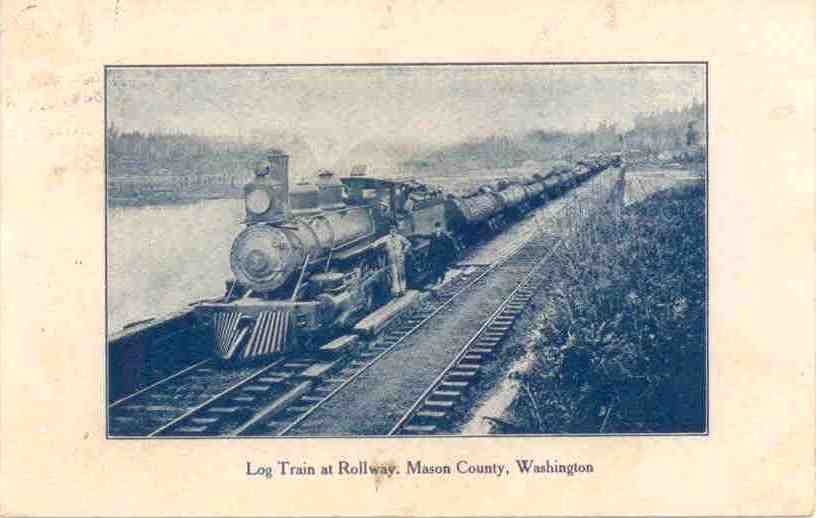
Log Train at Rollway
Log Train at Rollway Mason County Washington

by Mary Katherine May

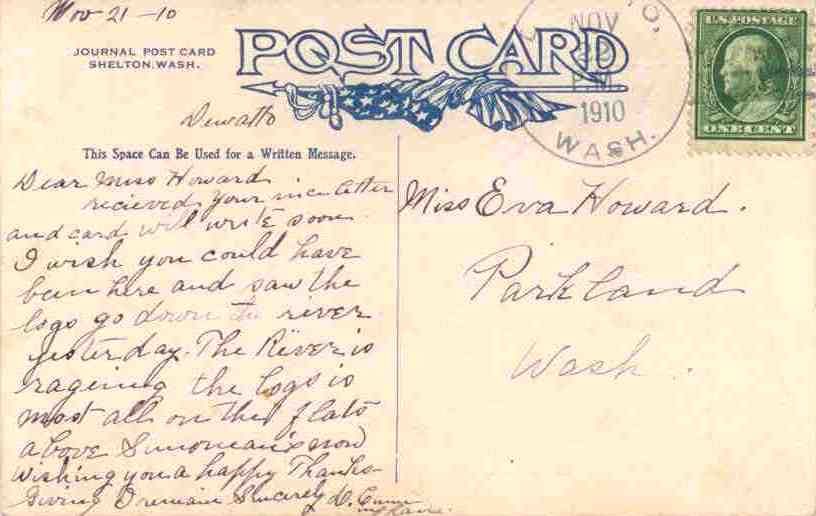
Here is a great postcard mailed on November 22, 1910, from Dewatto, Washington.  There are two interests going on with this postcard, both subjects which have been perennial favorites among deltiological collectors.  The subject matter is (1) trains, and (2) logging.

Log Train at Rollway, Mason County, Washington
Postmarked Dewatto, Washington, 22 November 1910
     On the post card back, upper left, we are told that this is a Journal Post Card, Shelton, Wash.  It is a comfortable assumption to make that the post card was printed/published by the local Mason County Journal, a weekly publication coming out of Shelton, Washington.  Notice how the American flag is wrapped around the flag pole.  I also notice how few large diameter logs are on each flatbed, and since I know very little about the transport of logs by train, I cannot assume that it was possible to pile them as high as was done on the wagons that would bring the hewn logs out of the woods.

Reading (scroll down the link page) about Mason County, Washington, and the logging industry, I learned that after the Panic of 1893 great effort was taken to put loggers back to work, and that the advent of steam locomotives in this area helped both the logging industry as well as aided in clearing land for agriculture. 

FreeDictionary.com defines what a rollway is: an incline down which logs are rolled for transportation.

In regard to real photo postcards, the image on this post card is not a RPPH.  If you look closely, you will see that the image is comprised tiny dots which a type of printing called halftone.

DEWATTO, WASH.
November 21, 1910. Dear Miss Howard...
     Even more interesting is that the writer of this particular post card gives us a first hand account, although, brief of her message may be,  of what it was like to view logs being floated down river and on the train.  Also of interest is the writer's manner of addressing the recipient, as Dear Miss Howard.  Was this a teacher writing to a student?  or, simply a person observing a formality?

Nov 21 --10
Dewatto

Dear Miss Howard,

received your nice letter and card will write soon.  I wish you could have been here and saw the logs go down the river yesterday.  The river is rageing the logs is most all on the flats above Simoneau's now wishing you a happy Thanksgiving

I remain
Sincerely
D. Cunningham

Wednesday, June 20, 2012

Artist Painted Post Cards Maud Leach Denver Colorado

Maude Leach, artist
Leach Art Studios, Denver
Maude Leach
(1870-1927)
Margaret Amelia Thornton
(1882-1962)

by Mary Katherine May of  QualityMusicandBooks.com.

Looking at postcards in antique and collectible shops is a time consuming effort if you are interested not only what the photograph or image is on one side, but in the message on the opposite side as well.  Some shops are very obliging and helpful, and others not so much.  We all do what we must in our circumstances, and so the less obliging are left respectfully with all their postcards still in inventory, and those who really do wish to make a sale are left instead, respectfully, with my money.

Blooming Bushes in
Hutchinson, Minnesota
Kathy, my childhood friend, went on a drive with me recently.  At the end of our time we stopped in the small but bustling town of Hutchinson, Minnesota, fondly known to many of its residents as "Hutch." 

Before sitting in the lovely, peaceful park created by the town's girl scouts, Kathy patiently went along as I browed my way through the antiques.  In actuality, I generally browse the books, post cards, and ephemera--or anything paper.

My offering to you today, after this story, is a postcard with a soft, gentle scene of mountains and sky, that I found in Hutchinson.  The postcard is stamped, Leach Art Studios, Denver.  The penciled name in the lower right, Allie, I believe to be the sender of the postcard, which went to a Miss Madge Thornton in St. Paul, Minnesota, leaving Denver, Colorado, on March 22, 1907.


There is no message as you can see, for why would the sender, Allie, ruin this beautiful scenic illustrations of Colorado with a message.  There could have been a message written on the address side of this undivided back post card, because just 21 days prior to its use, on March 1, 1907, writing on the address side was first allowed by the United States Post Office.  I wonder if Allie knew? 


What intrigued me enough to purchase this particular postcard is the art.  I don't know at this point if it is an original watercolor or other form of painting, or perhaps printed from original art?  It isn't signed, but did this artist Leach always sign the paintings?

Maude Leach, artist. Leach Art Studios, Denver
I haven't found out much about Maude Leach the artist.   Maude Leach (1870-1920), sometimes spelled Maud Leach or Maud Leech, did paint and created in the area of Denver, Colorado.  Maude began her life and studied in the East, specifically New York, but would have been living in Colorado in 1907.  She liked to paint mountains and surrounding scenery, maintained a studio, and for a few years was a public school teacher.

Searching the internet and looking at google images under the name of Maude Leach and variations thereof, I discovered that the art on this postcard looks to be exactly like what she painted.  Also, the paper upon which this post card is illustrated is very similar to the watercolor paper I bought for myself at the local Michael's store. 

I noticed that the word Post Card with its ruled border looks like it could have been stamped on, not printed.  Further indication of this possibility is that it is stamped on the back crooked in relation to the paper edge.

I have one more interesting historical point to present before signing off on this post.  Miss Madge [Margaret Amelia] Thornton, born 1882 and a 1904 University of Minnesota graduate, member after graduation of the AAUW (American Association of University Women), in 1907 lived at 369 Von Minden Street, which later was renamed Michigan Street. She was one of twelve children born to Patrick H. Thornton and Margaret Monica Moran, her father being an immigrant from Ireland. Margaret went on to marry Frank Michael Kieron, who together birthed six children of their own.  Allie, our post card sender, may have been her sister, Alice Marie, but we don't know.  Margaret went home to the Lord on April 19, 1962. 


It is the address that is interesting.  It was not discovered until torn down that the the house, known as the Schneider-Bulera House, at 369 Von Minden Street had been built in 1857, one year before Minnesota entered the Union (May 11, 1858), and just fourteen years after Father Lucien Galtier changed the town's name of Pig's Eye Landing to St. Paul, his favorite saint, and was the oldest house still standing in St. Paul. But in the small amount of history that is available on the web about this house, there is no indication of the Thornton family residence.  Interesting.

One last thought, and it is a sad one, because history's moments, though in the past are the source of the roots that make up the character and fiber of our families, towns, cities, states, and nation.  We are who we are because of history, each relational moment being spiritually and/or physically defining what is, and thus our future has its base beginning point in the past.  On that note, I have a touch of sadness in my heart as I quote from the Schneider-Bulera House link:

To quote a city official when the previous oldest house in Saint Paul was torn down by United Hospital several years ago "There will always be another oldest house!" ~Joe Hoover

Saturday, June 16, 2012

What About Baudette Minnesota and Herding Goats in Norway Postcard Talk

From Leslie to Hulda Hilden


Orginal Postcard, enhanced.


Original Postcard without Enhancement


I began looking at this postcard, thinking I knew at least a few details, only to find that I knew even less of the little that I thought I did know!  After closer examination with 10X magnification under better light, I discovered that the photograph, at least revealed a little more upon which to speculate.


The postmark that I had assumed was for Thief River Falls, Minnesota, it turns out is not.  The word THIEF is there, but there is no river or falls.  A closer look also reveals tht the faint letters on the right outside circle of the postmark can in no way spell out Minnesota; or, as it would have been in the year this card was mailed,  MINN.  Clearly readable, again, is the word, THIEF, AUG 7, and EAST. Beneath that, is possibly M.P.C., and at the top might be the year--1911? 

So much for that.  The stamp is a one cent Franklin. And it is addressed to Miss Hulda Hilden in Beaudette, Minnesota, from Leslie--who may have been her brother.  More specifically, the brief note suggests a good relationship with plenty of camaraderie and joking.  The joke on this postcard would take inside knowledge to decipher the hidden meaning.

Well here is the mail man you were waiting for but I hope I haven't keep you waiting all this time with the same kind of  a costume on the the girl on the card you sent me had.

Leslie

Evidently Hulda had sent him a jokester-type card?  I wonder what the postcard looked like that Hulda had sent to Leslie--is this her brother?

I just heard that your old pal Ole was herding goats in Norway and that he had 2 new hairs.

It seems that Ole at least, maybe without Lena, was the brunt of jokes early in the 20th century!
Well...on with the discovery!


The photograph is hard to decipher for the soil and darkening with age, and also as it is a large area that was included, everything is smaller and less distinct.  Unfortunate in this case is that enlarging the picture makes determining details even more difficult.  My 10X power headgear and a good light did help some, however.  Though very small, a flag is visible atop the building in the background.  With a closer look it can be seen that there is another American flag in front of the building.

There are posts, but there appears to be no fence.  There are three groups of people, yet in none can it be discerned as to what is being looked at.  The closest men, on the left, have hats that look to be part of a military or official uniform.  That they have on neckties is not a defining detail, as in the era of the photo dress was much more formal for nearly all occasions.  At least one of these men is looking to his right.


Next is the group in the middle.  What are these people, both men and women, looking at?  It isn't what the others are viewing to their right or left, because they face the house with their backs turned toward the camera that took the photograph.  This middle cluster is looking toward the building.  They don't seem to be looking up, but across.

At the furthest distance, people group 3, maybe have some people sitting and some standing, or they might be seated on bleachers.  I don't know.  What they are looking at, perhaps a ball game? 

Please Allow me to summarize at this point what I don't know.

1. The postmark year.
2. The location of the sender.
3. The year of the stamp issue.
4. What the three groups of people are looking at.
5. What the Norwegian Ole joke means.
6. If Hulda and Leslie are related.
7. What M.P.C. means.
8. If some of the men in the photograph are wearing part of a uniform.
9. What kind of woman was on the postcard sent by Hulda to Leslie.

Yup.  You guessed it.  I don't know much.  I would appreciate viewer input.  Maybe my knowledge will increase. ...Mary Katherine May

Monday, April 30, 2012

Postcard Talk Is the Forerunner of the Cloverleaf Bridge in Hastings Minnesota

Spiral Bridge ~ Hastings, Minnesota
Postcard Talk
Is the Forerunner of the Cloverleaf Bridge in Hastings Minnesota???

This article written by Mary Katherine May of QualityMusicandBooks.com.

I generally don't add unused postcards to my collection.  On one of last week's searches for Minnesota and surrounding states postcards (a.k.a. the Mid-Midwest), however, this postcard caught my attention.  It wasn't only the intense colors, but also the shape of the bridge.

This bridge is NOT a cloverleaf interchange, though that was the first thought that came to me.  I looked it up. The Spiral Bridge pictured on this postcard was erected in 1894.  The first cloverleaf bridge interchanges came along about twenty years later.  Did someone see a photograph or image of the bridge in Hastings?  Without knowing for certain, speculation is always an option.  Maybe an engineer saw it and thought, "Hey! Why don't I just take this loop, loop four times and...Well, by golly! It's a cloverleaf!

Even without the message there is a lot of history to be learned from this postcard. Most of what I could tell you, however, has been told quite well on other sites.  I have made an executive decision about it, and this time am giving the short synopsis version with links.

Spiral Bridge, Hastings, Minnesota
There are quite a few sites that offer information about this unique bridge--why it was built, the impact it had on Hastings as a point of interest, how long the bridge was used and its current status.

History of the Spiral Bridge
Hastings is a great place for its many historic buildings and sites, including the Spiral Bridge.
A replica of the bridge can be viewed at Little Log House Pioneer Village near Hastings. 
Minneapolis StarTribune article about the new bridge that replaced the Spiral Bridge.

Meloy Park ~ Hastings, Minnesota
Meloy Park
John C. Meloy, born in Cambria County, Pennsylvania, settled in Hastings, Minnesota in 1856, before Minnesota entered the Union (1858).  The river port in Hastings was one of the stopping points before traveling north to Fort Snelling.  In the lower right area of the postcard, there is an arched entry into the park named for Mr. Meloy, whose location is below the Spiral Bridge.

The Beginnings of Hastings, Minnesota History: First Hand Accounts
In my years of study, I have always found that learning about the past is at its most fascinating when reading first hand accounts.

Though the back of this postcard is blank except for a brief comment written with  fountain pen, there is still historic information of interest.  On the left edge of the card, we read that this postcard was Made in Germany. This tells us that it was printed before World War I. Studying the affects war has on all aspects of life is a good lesson learned for both the present and the future.


In the same area is stated that this card was published by J. G. Sieben, Hastings, Minnesota. Who was J. G. Sieben?  What did he do in Hastings?  What role did Mr. Sieben's family play in Minnesota?  These are all good questions with application to learning about how history impacts the future.  As it turns out, J. G. Sieben, who went by the name George, and other members of his family did impact both Hastings and Minnesota history.  For instance, they served their city and state by taking active roles in political and relevant social projects and issues.  J.G. was a druggist, photographer, mayor of hastings three times, husband and father, and active in his church.

Also on the postcard back is a Litho-Chrome logo.  If you do much research with old documents, you will understand how knowing about printing and paper helps in identification depending upon the era or century. 


This postcard was printed using a process called Litho-Chrome (scroll down the page).  MetroPostcard.com, site for the Metropolitan Postcard Club of New York City, is an impressive excellent reference and learning site. The page link describes litho-chrome printing (and other printing processes): A German made card printed in blue collotype over red and yellow spatter. It explains the color, too. So I cropped out a part of the postcard image to look for the spatter.  Can you see the spatter?


There isn't much more to see that is obvious except for one last detail, which is the stamp box.  It is an advantage with unused postcards because of being able to see the stamp box with printing.  This one states: Postage United States and http://en.wikipedia.org/wiki/Bureau_of_Insular_Affairs, Cuba, Canada, and Mexico ONE CENT. For all other Countries TWO CENTS.

A few hours looking around, asking obvious questions, has been not only entertaining but educational. I have been to Hastings a few times, not too far south of the Twin Cities of Minneapolis and St. Paul.  It just may be time for another, more in-depth visit!

Sunday, April 22, 2012

July 1910 Excursion to Osseo and Robbinsdale Minnesota

City Hall and Park
Osseo, Minnesota
July 1910

Presented by Mary Katherine May (amateur history detective)
of QualityMusicandBooks.com.


Osseo, Minnesota City Hall and Park

There is something so delightful in finding a postcard written over 100 years ago not far from where we live.  A girl or young lady named Esther wrote the postcard, but beyond that she will at this time remain anonymous.

So many interesting points can be found on this one little card! The illustrated side of the postcard show the Osseo, Minnesota, City Hall and Park. In the back ground is what looks like a large residential building, and on the park ground I can see a wood platform.  Since the postcard was written on July 25, perhaps the platform was used for a program in relation to independence day.

Esther gives us bits of news that tempt my imagination.  There was a storm with strong winds and Sadie Ward's tree blew down. Was it Sadie's tree, or was it the Ward family's tree?  Since Esther mentions both Osseo and Robbinsdale, in which town did Sadie live?


July 25, 1910(?)
Robbinsdale Minn.

Dear Ruth
We are having so much fun.  We were to Osseo Sat. with Mr. B-. and we had a ice cream cornet.  Sun. morning we went to Robinsdale to meet some people.  Mr. Benells nieces and his son Hilmar.  We had our pictures taken.
Goodbye. Esther.

P.S. Twelve people came besides us. We had a swell dinner with spring chickens. Write soon.

We may assume that Esther was part of a group of young people with perhaps a teacher as a chaperone on an excursion, maybe from South Minneapolis since the card mailing address is there.  The novelty in Osseo was to have an ice cream cornet, which would be the same or similar to what we call a waffle cone today.  Though ice cream was sometimes served in cones for many yearsin Europe already, it may still have been a novelty in Minnesota at that time since the first big splash of attention the cone, or cornet, received was just a few years previous in 1904 at the St. Louis World's Fair.

The next morning the group left Osseo for Robbinsdale, which would have been on the way back to Minneapolis. To drive from Osseo to Robbinsdale now takes a15 to 20 minutes traveling between 40 to 50 miles per hour.  I wonder how long it would have taken in 1910.  They were joined by their chaperone, Mr. Benell's son Hilmar in Robbinsdale, where there was a large group who had a "swell" dinner of spring chickens.

The house we live in wasn't built in 1910, but if it were this group on a holiday would have passed our home on their way south to Robbinsdale.  I wonder if they went by horse driven wagon, buggy, or an early motor car?  Or, they may have taken the train--the tracks just a couple blocks from our home still carry trains, and maybe the trip out and back was accomplished in good time, all traveled on the Iron Horse.

I can imagine that Esther was very happy for some time after such a delightful trip, and had a lot of news to tell her friends and family when she returned home.

Should someone familiar with any of the people mentioned on this postcard see this blog post, it would be wonderful to be able to add an image of the  photograph here that was taken on that Sunday in July as mentioned by Esther.  Also, if a viewer could verify the year, which I am reading as 1910, I would appreciate the information.  I can be emailed through this blog site or through our webstore, QualityMusicandBooks.com.

Osseo City Hall, 1910


Saturday, March 31, 2012

EMIL NELVING ELMORE MINN Will He Find His Uncle Emil?

Postcard from Emil Nelving to Emil Oldenburg
Elmore, Minnesota to Waterloo, Iowa
Postmark December 9, 1910
Postmark: Dec 9 1910
Elmore Minn.

Addressee: Mr. Emil Oldenburg
Waterloo, Iowa

Dear Uncle,

I am going to Hampen Ia this weak and I thot I would come and see you I coming from Hampen Monday so if you got to come to met me I would be very glad because I dont no if I can find you.

Emil Nelving

We must assume that Emil Nelving was actually going to Hampton, Iowa, to see his Uncle Emil Oldenburg because there is no Hampen, Hampden, or Hampdon.  Even then, though Emil didn't know exactly where his namesake uncle lived, there was a greater problem since the postal service needed to find Uncle Emil also because the addres was incomplete.  All that can be concluded is that Nephew Emil knew that Uncle Emil lived in the vicinity of Waterloo, Iowa.

The estimated time to drive the 154.4 miles in 2012 from Elmore to Waterloo is just under three hours. I wonder how long it took in 1910.  There was train service from Omaha, Nebraska to Elmore, where the train turned around and went back to Omaha.  If this service existed in 1910, and Waterloo was been on the train route or nearby, then Nephew Emil may have used this mode of travel.

Let us hope that the two eventually found each other.  If I found Iowa jokes funny, I might write the last sentences as follows. let us hope that the two eventually found each other somewhere among the Iowa cornstalks. Ya, shure!

The town of Elmore is on the border of Minnesota going into Iowa.  The most current population census reports that just under 700 souls occupy this space in Faribault County.  First named Dobson, it is thought that the name was changed to honor one Judge A.E. Elmore, though there is no documentation that the Honorable Elmore ever visited the town that honored him.  There is a brief, interesting history of Elmore written by Kathy Gill by CLICKING HERE.

Real Photo Postcard of Unidentified Home
Unfortunately for me, this real photo postcard had substantial soil on the photograph side, which though for the most part successfully removed, in the process I also damaged the image.  The house and yard may have belong to the Nelving family, but without a family member identifying its ownership we will never know.

Prepared by Mary Katherine May of QualityMusicandBooks.com.